Thursday, December 29, 2005
Konstantin's Russian Blog on Ukranian-Russian Gas Negotiations
Konstantin has a Russian perspective on the latest dispute between Russia and Ukraine. He seems to be saying now that Ukraine has left Mother Russia's embrace, the country will have to pay pay the price--some 3 billion dollars a year for Russian natural gas...


Wednesday, December 28, 2005
Nicholas Sarkozy Podcasting From Paris
Yannick Laclau has the story. The more I hear about Sarkozy, the better I feel about France...
UPDATE: Here's a link to another video blog with Sarkozy's interview.
UPDATE: Here's a link to another video blog with Sarkozy's interview.
Central Asia's Second Chance by Martha Brill Olcott

Martha Brill Olcott's valuable new survey of Central Asia has appeared at a tricky time. Clearly, the study of Kazakhstan, Kyrgystan, Tajikistan, Turkmenistan, and Uzbekistan was started with an optimistic spirit. It looks like a guidebook that could have been used for businesspeople, academics, students, and even tourists to the region that fills the center of the Eurasian land mass, Mackinder's famous "pivot point" of world history.
The Andijan violence of 2005 has clearly been a pivot point for regional geopolitics, and perhaps for President Bush's Global War on Terror. In the aftermath of what the Uzbek government declared was a terrorist attack on a major population center, the US and EU condemned the government for "excessive force," demanding an international investigation. China and Russia, on the other hand, backed authoritarian leader Islam Karimov's decision to fire on armed demonstrators holding hostages, who had earlier seized several government buildings and set fire to movie theatres. To answer riot and rebellion with Napoleon's "whiff of grapeshot" seemed logical to the East, if not to the West.
This split had spillover effects. In its aftermath, Karimov ordered troops out of the US base in Uzbekistan and signed an alliance with Russia. It marked a geopolitical defeat for the United States, and the first instance where Bush's "democracy" policy took precedence over military requirements for the Global War on Terror. Deprived of its base in Uzbekistan, the US was then squeezed by Kyrgyzstan, which asked for some $200 million dollars to keep open Ganci airbase--100 times what the US had been paying previously.
Round One: Russia and China, by a knockout.
Olcott's book is fascinating, as much for what she does not say, as for what she does. For while she states that "Blame Lies with the Region's Leaders," (p.234), the data in her book equally support an alternative hypothesis which goes unstated: American policies have not only harmed Central Asia, they have damanged the strategic interests of the United States.
Evidence for this hypothesis can be found in remarks scattered throughout the text, like clues to a Sherlock Holms mystery. For example:
For a certain group of policy makers, those concerned with monitoring the democratic progress of these governments, the leaders in charge of these states have effectively become the enemy, men whose departure from political life was viewed as a good thing for their populations . . . The US foreign assistance strategy has led to much ill will on all sides, without substantially enhancing the capacity of either government or opposition to govern in a democratic fashion.(240)Olcott's book seems to end suddenly--without a customary concluding chapter on p. 244. Instead of tying together loose ends, pages 245-387 present is a mass of raw data in appendices containing charts and graphs; footnotes with fascinating tidbits, and a valuable index.
This silence about her key message seems very Central Asian. If one digs through the data sets, one comes up with a picture of a region that is closer to the one presented by its authoritarian leaders than the one found in reports by NGOs such as Human Rights Watch or the International Crisis Group.
Central Asia is not poor. In fact, the region's economies are growing. There is considerable foreign investment, especially in oil, gas, and mining sectors.
Central Asia is not backwards. In fact, the countries enjoy literacy rates higher than the USA.
What is most striking is Oclott's evidence that Central Asian leaders have not invented the extremist Islamist threat in order to maintain power. The threat from extremism is real. Like Thailand during the Vietnam War, these countries have adopted authoritarian policies to prevent conflicts raging around them from exploding among their populations.
And Olcott almost says this--with caveats blaming Uzbek leadership failures--in a section called "Uzbekistan: Central Asia's Frontline State." Where she points out this little reported fact: "Uzbekistan was the only Central Asian state to join the US-led coalition that invaded Iraq, despite the fact that this damaged its relations with Russia and China."(177) In other words, attacks on Uzbekistan--including Andijan--were attacks on the US-led coalition.
There is more detail in Appendix 13, listing both official and unofficial Islamic organizations--some of which have documented ties to Al Qaeda in addition to the Islamic Movement of Uzbekistan, for example the "Jamaat of Central Asia Mujahideen." This group, according to Olcott, "remains focused on terror acts in Central Asia." She also notes that Tajikistan's "Baiat" (covenant) has perpetrated terror attacks against both non-Muslims and "Muslim grops that it considers too moderate."
This is a book that I am sure to turn to again and again. It is a treasure trove of information that is useful to anyone attempting to understand why what is happening in small countries that are far, far away has relevance to the lives of ordinary Americans, and for improving chances for world peace.
Andrei Malaev-Babel as Isaac Babel
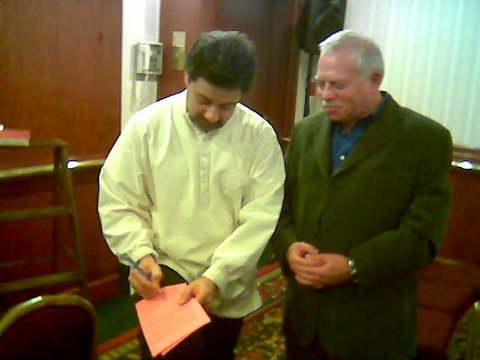
After last night's one-man show by Andrei Malaev-Babel as his grandfather, the legendary Russia writer Isaac Babel, audience members lined up for the actor's autograph. Malaev-Babel's performance of Babel: How It Was Done in Odessa took place in a very small room that was filled to the rafters with Russian teachers attending the national American Association of Teachers of European Languanges convention in Washington. The room was so full that I had to share a small shelf with a teacher from Boston, who told me she had flown down just for the show. As we were pressed into our little box, I thought of the old Russian saying: "Close together, but no offense."
The audience seemed a little disappointed that the main event was perfomed in English (due to a misunderstanding, apparently), though it certainly made it easier to follow with my basic/intermediate language skills. Malaev-Babel redeemed himself at the end with a short recitation in Russian, that was a big hit.
The stories in English were Di Grasso from Stories 1925-1938; How It Was Done in Odessa from The Odessa Stories; and Guy de Maupassant also from Stories 1925-1938. The final scened in Russian was set in a Jewish cemetery, and a meditation on death. It received warm applause.
Malaev-Babel's performance is a very Russian-style evening, evidence of his training at the Schukin School of the Vakhtangov Theatre Institute in Moscow. He takes Stanislavsky and Danchenko's commitment to artistic truth as his own. For some Americans, the style might seem a bit slow, but to this viewer it seemed just right--free of cheap theatrics and antics that clutter up too many stages nowadays. It was a classical rendering of a classic set of tales. The tragic fate of Babel, shot on Stalin's orders, was known to this audience, which gave the evening a poignant and soulful quality. And Babel's Jewish themes made for some appropriate Hannukah entertainment.
In the question and answer session afterwards, Malaev-Babel came across as a charming and thoughtful actor-director, dedicated to his art, his family legacy, and to truth. When asked how come he went into directing, he modestly answered that it was his teacher's choice. "You are too smart to be an actor," he was told, "actors are dumb." Malaev-Babel said he disagreed with that viewpoint, but he went ahead and became a director anyhow.
Next for Malaev-Babel's Stanislavsky Theatre Studio--Dostoevsky.
Tuesday, December 27, 2005
My Phish Story
Over the Christmas holiday in Florida, I got "Phished." I never heard the term before, and learned it when I called American Express to notify them that I had--incredibly stupidly--given personal information on a fake eBay website, in response to what I quickly discovered was a phony eBay suspension letter. This is part of how they pull an identity theft. It turns out that when phony spam--called "spoof"--hooks a sucker, the sucker has been "fished". "Oh, I'm so sorry," said the operator, "you got fished." Who then told me about a new American Express identity protection insurance plan that I could get for six dollars a month, that would pay up to $15,000 in legal expenses.
I had notified eBay immediately, via a LiveAdvisor popup email exchange.And eBay were pretty good about it. They referred me to the eBay identity theft webpage. I stopped filling out the phony form before putting down my credit card numbers or bank accounts, but unfortunately did give out my social, driver's license, and some other personal info. To a fraudster! Ebay said they thought they may have wanted to use my account to order thousands of dollars of merchandise to someone else, and that they could be stopped without closing the account. We'll see. I got an email from their security office later, to confirm my report, very quickly. After all, their business surely would collapse if anyone could just steal anyone else's account...
So, I went down the eBay checklist. I notified the local police in Winter Park, in order to file a police report. When I called , they wanted to send a cop to our house, but it seemed to me that it might ruin the Christmas Cheer, so instead I went down to what I thought was the station house. Now, Winter Park, Florida is a classy place. So classy that the police station is unmarked. I drove around for a while until I realzed that it looks like an ordinary office building. It was nighttime, the front door was locked. So I picked up the phone by the door, and then got buzzed into the entrance. Where I sat and waited for about ten minutes in a nice Spanish-style office park lobby, until a patrolman emerged from somewhere. He didn't seem too excited. He said he used eBay himself. Told me not to cancel my eBay account, just change my password. And don't go crazy getting a new social or driver's license, either. The policeman, who didn't seem to feel my pain, said that until something was charged to my credit card, no big crime had really been committed. I told him that I thought that fraud had been committed, someone pretending to be eBay had gotten my personal information under false pretenses. He said anyone could get the information that I gave out from a number of places for $40 (I didn't know that...). So long as I didn't give out my credit card numbers, or bank accounts, which I didn't, they probably wouldn't be interested. Too much trouble, he indicated. I hoped he was right. He did agree to give me an "event number" but not to file a full police report. How would you find them anyway, he concluded, they're probably in the United Kingdom. Now, why he thought it was a British gang, I don't know, except that a local Orlando barber shop owner had just been arrested for wire fraud. They have a pretty laid-back attitude in Winter Park. But I guess at least so far, the policeman was right.
So, that's how I came to call American Express, and learn that I had been caught in a "phishing" scam.
In any case, when I got home, the people I were staying with laughed and laughed. They had heard about it on TV, someone had reported on a similar scheme with Pay Pal. And the person I was travelling with had already deleted her spam. And how did they get this information about you? my hostess asked. "I gave it to them." More laughter.
Of course, I went through the recommended eBay steps, notified the relevant parties, changed my passwords, and was sure to file a "fraud alert" with the credit agencies. That's so anyone trying to open a phony bank account, get a credit card, or buy something on eBay--"One guy bought a house with a phony identity," my AmEx operator told me--would be double-checked.
It may have been a coincidence, but when I got to the airport to take my flight home a couple of days later, I was pulled aside by security, who noted that my boarding pass had a big "S" for special search (not "sucker", I hoped). I was guided to a special area where a team went through my bags as I was patted down and frisked by a man with rubber gloves.
Locking the barn door after the horse is gone, here's a link to the Federal Trade Commission's helpful website How Not to Get Hooked in a Phishing Scam.
I had notified eBay immediately, via a LiveAdvisor popup email exchange.And eBay were pretty good about it. They referred me to the eBay identity theft webpage. I stopped filling out the phony form before putting down my credit card numbers or bank accounts, but unfortunately did give out my social, driver's license, and some other personal info. To a fraudster! Ebay said they thought they may have wanted to use my account to order thousands of dollars of merchandise to someone else, and that they could be stopped without closing the account. We'll see. I got an email from their security office later, to confirm my report, very quickly. After all, their business surely would collapse if anyone could just steal anyone else's account...
So, I went down the eBay checklist. I notified the local police in Winter Park, in order to file a police report. When I called , they wanted to send a cop to our house, but it seemed to me that it might ruin the Christmas Cheer, so instead I went down to what I thought was the station house. Now, Winter Park, Florida is a classy place. So classy that the police station is unmarked. I drove around for a while until I realzed that it looks like an ordinary office building. It was nighttime, the front door was locked. So I picked up the phone by the door, and then got buzzed into the entrance. Where I sat and waited for about ten minutes in a nice Spanish-style office park lobby, until a patrolman emerged from somewhere. He didn't seem too excited. He said he used eBay himself. Told me not to cancel my eBay account, just change my password. And don't go crazy getting a new social or driver's license, either. The policeman, who didn't seem to feel my pain, said that until something was charged to my credit card, no big crime had really been committed. I told him that I thought that fraud had been committed, someone pretending to be eBay had gotten my personal information under false pretenses. He said anyone could get the information that I gave out from a number of places for $40 (I didn't know that...). So long as I didn't give out my credit card numbers, or bank accounts, which I didn't, they probably wouldn't be interested. Too much trouble, he indicated. I hoped he was right. He did agree to give me an "event number" but not to file a full police report. How would you find them anyway, he concluded, they're probably in the United Kingdom. Now, why he thought it was a British gang, I don't know, except that a local Orlando barber shop owner had just been arrested for wire fraud. They have a pretty laid-back attitude in Winter Park. But I guess at least so far, the policeman was right.
So, that's how I came to call American Express, and learn that I had been caught in a "phishing" scam.
In any case, when I got home, the people I were staying with laughed and laughed. They had heard about it on TV, someone had reported on a similar scheme with Pay Pal. And the person I was travelling with had already deleted her spam. And how did they get this information about you? my hostess asked. "I gave it to them." More laughter.
Of course, I went through the recommended eBay steps, notified the relevant parties, changed my passwords, and was sure to file a "fraud alert" with the credit agencies. That's so anyone trying to open a phony bank account, get a credit card, or buy something on eBay--"One guy bought a house with a phony identity," my AmEx operator told me--would be double-checked.
It may have been a coincidence, but when I got to the airport to take my flight home a couple of days later, I was pulled aside by security, who noted that my boarding pass had a big "S" for special search (not "sucker", I hoped). I was guided to a special area where a team went through my bags as I was patted down and frisked by a man with rubber gloves.
Locking the barn door after the horse is gone, here's a link to the Federal Trade Commission's helpful website How Not to Get Hooked in a Phishing Scam.
Hannukah in Santa Monica
From our Believe It or Not Department: Over Christmas, we heard Garrison Keillor sing this 1963Tom Lehrer classic on NPR. By some incredible coincidence, opening the mail at home today, I found that my father sent me Lerhrer's song (and some others) as a Hannukah present...Happy Hannukah, Dad!
You can find a complete collection of Tom Lehrer song lyrics at this website.
You can find a complete collection of Tom Lehrer song lyrics at this website.
The American Thinker on Edward Rothstein on Stephen Spielberg
I read Edward Rothstein's excellent NY Times article dissecting Spielberg's Munich on the airplane yesterday, while flying home. He's nailed Spielberg--and collaborators such as "playwright" Tony Kushner (who once yelled at me at a sparsely attended pro-NEA rally when I tried to interview him)--dead to rights.
Wednesday, December 21, 2005
Merry Christmas, Happy Hannukah, Happy Kwanzaa!
We're taking off a few days for the holidays...
Happy Holidays!
Happy Holidays!
Konstantin's Russian Blog on NGOs in Russia
He links to an article on NGOs in South Africa, and notes that the law is similar to Russia's--yet Russia is criticized, while South Africa is not. He also has an interesting defense of Putin's policies, in response to former American diplomat Richard S. Williamson's recent attack.
BBC: Nerve Gas Attack in Chechnya
This is a disturbing news report from Chechnya, if true, because it may mean that the genie is out of the bottle for terrorist nerve gas attacks.
Which makes the FBI failure to solve the 2001 anthrax attacks even more troubling.
And may make President Bush's failure to find WMD in Iraq even more of a problem--what if some dangerous chemicals were "handed off" to others?
Let's hope that it isn't nerve gas (but unfortunately, it was anthrax). One nerve gas attack in New York City at Christmastime, and Bush will be in deep voodoo, as his father used to say.
Which makes the FBI failure to solve the 2001 anthrax attacks even more troubling.
And may make President Bush's failure to find WMD in Iraq even more of a problem--what if some dangerous chemicals were "handed off" to others?
Let's hope that it isn't nerve gas (but unfortunately, it was anthrax). One nerve gas attack in New York City at Christmastime, and Bush will be in deep voodoo, as his father used to say.
Intelligent Decision
Today's Washington Post has an excerpt from Judge John E. Jones III ruling in Pennsylvania's "intelligent design" case:
Since the scientific revolution of the 16th and 17th centuries, "science has been limited to the search for natural causes to explain natural phenomena," Jones writes, noting that the scientific revolution was explicitly about the rejection of "revelation" in favor of empirical evidence.
Since then, he writes, "science has been a discipline in which testability, rather than any ecclesiastical authority or philosophical coherence, has been the measure of a scientific idea's worth."
Anne Applebaum: Bush Mocks Rule of Law
 Anne Applebaum is sometimes more anti-Russian than necessary (perhaps because her husband is Polish Defense Minister Radek Sikorski), but today's commentary on President Bush's undermining the rule of law in the US hits the mark. The bigger question coming from all the scandals swirling around the National Security Agency spying controversy is simple: How can the US have credibility urging rule of law for other countries while an American President shows contempt for the rule of law at home?
How About Those Redskins?
When the Washington Redskins beat the Dallas Cowboys the other day, there was definitely joy in Mudville--at least inside the Beltway. As New York seems to decline, Washington appears to be on a roll. Metropolitan area population -- 4 million and growing. I've haven't seen so many fancy cars since I lived in Los Angeles. The other day I watched as a Rolls-Royce drove into the Mazza Gallery parking entrance. So far, no major strikes, either (let's hope it stays that way).
NYC's Transit Strike -- A Blast from the Past
 To any native New Yorker (I was born in Manhattan), the news that NYC's MTA strike is now in its second day has a nostalgic ring. The clock has turned back to the pre-Giuliani way of life. For some 20 years, New York has been relatively strike-free. Mayor Giuliani cleaned up the city, and kept the unions in line. It was, it appears, like Camelot, doomed not to last. This strike is a sign that something is going wrong.
Another sign was Mayor Bloomberg's choice of Raymond Kelly as police chief--he was widely reputed to have turned the city into a crime disaster area under Mayor Dinkins, so why on did Bloomberg bring him back? Surely, there was someone else who could do the job.
We were in Manhattan not so long ago and the signs of decay were everywhere--garbage swirling in the wind, a hustler trying to pull a fast one on a Starbuck's cashier, menacing figures and homeless wandering the streets. This phenomenon has been noticed by others, including Taki in his Spectator column, and a another friend of ours just back from a visit.
As New York City's elevator operators used to ask: "Going down?"...
Tuesday, December 20, 2005
Daniel Pipes on America's War on Terror
...And other things, in this article. I agree with Pipes that things may be getting worse, especially vis-a-vis the Islamist issue. However, Pipes might need to bite the bullet and admit that one reasone is that President Bush has not exercised proper leadership in this or other fields (remember Hurricane Katrina and "Heck of a job, Brownie?". If things are going wrong, the buck stops (and should stop) with the President. He needs to stop saying "Trust me."
Top Spy Says US Bases Threaten Russia
Flash to Ambassador Fried! After your remarks rejecting Russian self-determination, according to the Moscow News, Russia wants to close US bases in the former Soviet Union because they may pose a threat:
Russia’s foreign spy chief said military forces from other countries deployed at bases along Russia’s periphery are a threat to the nation, the Associated Press news agency reported Monday.
In comments that appeared directed at U.S. forces deployed on bases in former Soviet countries, the agency quoted Sergei Lebedev, head of the Foreign Intelligence Service, as saying that Russia no longer had a “main adversary” like during the Cold War.
But “Russians cannot help but be concerned about new military bases and military contingents being deployed around our country,” he was quoted as saying.
Russia has watched warily as the United States deployed forces to the Central Asian countries of Kyrgyzstan and Uzbekistan and strengthened military and political ties with Ukraine and Georgia. Also, the three Baltic nations of Latvia, Estonia and Lithuania joined NATO in 2004 despite Moscow’s strong objections.
The War Against Christmas . . .
. . .is nothing new, nor is it particularly American, or anti-religious. It is at least as old as the Puritan movement, faith of New England's settlers--Christmas was banned in Boston for 22 years. Among other prominent anti-Christmas activists was the English Lord Protector, Oliver Cromwell, who outlawed it.
Monday, December 19, 2005
WSJ: Earthquake Aid Boosts US Image
It seems that actually helping people, instead of lecturing them, had made America better liked in Pakistan, according to an article in the Wall Street Journal:
Long a stronghold for Islamic extremists and the world's second-most populous Muslim nation, Pakistanis now hold a more favorable opinion of the U.S. than at any time since 9/11, while support for al Qaeda in its home base has dropped to its lowest level since then. The direct cause for this dramatic shift in Muslim opinion is clear: American humanitarian assistance for Pakistani victims of the Oct. 8 earthquake that killed 87,000. The U.S. pledged $510 million for earthquake relief in Pakistan and American soldiers are playing a prominent role in rescuing victims from remote mountainous villages.
A Measure of Media Bias
Today's Drudge Report had an item about this report by UCLA professor Tim Groseclose and Jeffrey Milyo of the University of Missouri. So I googled the link to their original article. Here's the abstract:
Abstract: We measure media bias by estimating ideological scores for several major media outlets. To compute this, we count the times that a particular media outlet cites various think tanks and policy groups, then compare this with the times that members of Congress cite the same groups. Our results show a strong liberal bias: all of the news outlets we examine, except Fox News’ Special Report and the Washington Times, received scores to the left of the average member of Congress. Consistent with claims made by conservative critics, CBS Evening News and the New York Times received scores far to the left of center. The most centrist media outlets were PBS NewsHour, CNN’s Newsnight, and ABC’s Good Morning America; among print outlets, USAToday was closest to the center. All of our findings refer strictly to news content; that is we exclude editorials, letters, and the like.Now that there's a quantitative method to conduct such research, maybe the Corporation for Public Broadcasting might contract with Groseclose and Milyo as ombudsmen to scientifically study their entire program lineup on radio and television--instead of hiring Ken Tomlinson's political cronies, or retired journalists who may have axes to grind?
State Department Offcial Rejects Russian Sovereignty
 In a December 14th appearance at the American Enterprise Institute, the assistant secretary, Bureau of European & Eurasian Affairs, U.S. Department of State, appeared to challenge Russia's right to national self-determination (see boldface sentence in transcript below):
QUESTION: Thank you. I'm Vladimir Kara-Murza with RTVI Television, Russia. When you spoke about advancing democracy in the former Soviet region – Belarus, Kyrgyzstan – you didn't mention Russia. How does that – advancing democracy in Russia, is that an issue for the U.S. Administration, especially in terms of its relations with Putin?I think Fried may come to regret these remarks...
And then just quickly, is the U.S. prepared to cooperate with the European Union investigation on the detainee issue?
AMBASSADOR FRIED: Well, we have to find a phrase other than former Soviet space. You know, the United States doesn't usually refer to itself as the former British Colonial space. (Laughter.) It's over, okay? It's over.[Editor's note: What about all the anglosphere stuff?]
Russian democracy – the time is gone when nations could simply wall off the world and say non-interference in internal affairs is an absolute condition of state sovereignty. The United States has every – every country in the world is interested in the internal affairs of the United States. [sic, Fried may have meant to say Russia, a Freudian slip?]
Subscribe to:
Posts (Atom)