‘NOBODY LISTENED’ One of Many Cases of Censorship
by Jessica Rincon and Patrick White
Student paper for the Communication Studies Department, Concordia University, Montreal, Quebec, Canada
Dictatorships have been known historically to censor people’s freedom of expression. From the communist regimes in the Soviet Union to Saddam Hussein in Iraq, and today in modern day Cuba, people are locked up for questioning or disagreeing with the action, views, and or policies of their government. Regardless, people still try to make their voices heard. Nobody Listened is a documentary film that attempts to reveal the truth about one of the world’s most notorious dictators, Fidel Castro. After watching the film and researching the issues that relate to it, we found that this particular film is part of an even bigger issue of censorship that not only involves the censorship in Cuba, but also that of Cuban exiles in the United States of America. We will examine here the various ways that the documentary film Nobody Listened has been censored both in Cuba and in the United States.
Cuba is known to the world for having excellent literacy rates and an outstanding system of health care; however, most civilians consider this a myth created by the revolutionaries, since for decades Cubans have suffered under Castro’s dictatorship. Although some Cubans favor his government, a considerable amount has fled, mainly to the United States, to escape his regime and Cuba’s poor conditions of life. Castro censures people’s freedom of expression by arbitrarily banning any material (book, film, or article) he feels threatens his government principles, such as the declaration of Human Rights or a Cuban exile book, and labels it as “counter-revolutionary.” Since Castro first formed his government, 47 years ago, thousands of political and regular prisoners have been accused of committing crimes. What are considered crimes, as mentioned in the article Against All Hope: A Memoir in Castro’s Gulag, are things like being part of organizations defending Human Rights, sedition, possessing counter-revolutionary or non-authorized material, or if the person has been arrested before and is considered politically active, Castro will find any pretext, such as refusing government officials to fumigate the person’s house with substances she/he is allergic to, to arrest him/her (Valladares 1-2). They were, and are, taken to jails where they endure unthinkable abuses, ranging from horrendous tortures, forced labor and beatings, to “accidental deaths” and executions.
The documentary made by Nestor Almendros and Jorge Ulla, Nobody Listened, touches on these issues, questioning the general state of Human Rights in Cuba. The film is inspired by the book Against all Hope, where the author, Armando Valladares describes the experiences he and other prisoners went through. Nobody Listened is an expository documentary showing a series of people’s testimonies ranging from Castro’s former comrade, to priests and civilians that had been, or had a relative, in at least one of the prisons shown. Their stories are accompanied by footage or pictures supporting their testimonies, and on given occasions, the narrator explains further the images shown.
When one watches the movie, one realizes immediately why the film is censored in Cuba. This documentary is completely against the revolution, or better said, against Castro’s government since it reveals the stories of people that have gone through terrible tortures and somehow survived. It questions Cuba’s system of Human Rights and shows the discrepancy between what Castro and his “comrades” say is happening in Cuba versus what is really going on according to the everyday experiences of many Cubans. Castro has a remarkable ability, like any other tyrant, to ignore what the people are going through in his own country. He demonstrates his unwillingness to make things better when he said that “for those who hope for change ‘Let them sit down and keep hoping, because in Cuba there is no need to change a thing’” (Valladares 3).
The documentary also tackles the non-supportive response of Cuba’s government towards its exiles, as in the case with the directors themselves (Ulla and Almendros). This can be seen at the beginning of the movie when Ulla is trying to ask important figures of the government for their contribution, or their thoughts on the situation of Human Rights in Cuba, and they respond, if at all, with ambivalence, evasion or outright refusal to talk to him. Exiles are considered traitors to the country, and therefore, do not deserve any help. Also, it should be kept in mind that obviously exposing the real situation in Cuba is inconvenient for Castro. To this end, the reaction of the people in his government is to be expected.
It is understandable that due to such a dictatorship people who have seen this documentary in Cuba are few and far between, but what about in the United States, a country who prides itself on being the Land of the Free? Well, it seems that in the U.S there is a tacit sense of censorship, an implicit way of making decisions about what is broadcast since they cannot air everything is made in order to make everyone happy, and this is precisely why this documentary and others like it have been rejected. The censorship of the film Nobody Listened is not something that limits itself to films with explicit descriptions of the terrible things that certain people had to go through in Cuban jails, but is actually part of a bigger problem that Cuban American intellectuals face every day.
Although we could not contact Jorge Ulla, and Almendros passed away in 1992, we could get a hold of a friend of Almendros, the filmmaker (Covering Cuba series from one to four) Agustín Blázquez, who provided us with substantial information about the censorship of this type of documentaries, particularly in the United States. For years, intellectual Cuban exiles residing in the U.S have been discriminated against by the people who control the media and the ones in charge of promoting and distributing artists, filmmakers, and writers’ works. As mentioned in Blázquez’s article, Branded by Paradise and Maligned by Exile, there is a herd of “pro-Castro sympathizers in the U.S. media and in the film industry” (3) who, like the dictator they support, react in this way against people who do not share their political beliefs. An example of this is when Nobody Listened was rejected in 1988 by the New York Film Festival, the same festival that rejected Bitter Sugar (Leon Ichazo) and This is Cuba (Chris Hume); which are also films that contain as well controversial information about Castro’s regime. However, this trend did not go unnoticed because of the group of Cuban American filmmakers who protested against this decision, and among these protesters was Ulla. According to Blázquez’s article “Enough is Enough,” the director of the festival, Richard Pena, said that the films are chosen irregardless of their content. This is the same man who said that Improper Conduct, another film by Nestor Almendros, “attacks the stability of the Cuban revolution” (Blázquez 1). No correlation is shown between what the principle of the Festival seems to be and what actually happens at the end. It seems as if films of this sort are destined to receive little or no airtime.
In our conversation with Agustín, he sounded aggravated by the fact that although people like him had spent a great deal of time, money, and effort to produce and direct films with such an important message, and in a country where freedom of expression is so valued, are yet still censored. He felt helpless in relating that everything is about politics and about who controls public broadcasting. According to him, as repeated many times in both his articles and our conversation, a large part of the media and art world in the U.S., which includes filmmakers and festival organizers, are considered political Leftists. This means that in a free country like the United States, they have the right to express their views. At the same time, it is contradictory that precisely this situation is what prevents movies like Nobody Listened from being seen; as was the case with the festivals rejecting it, and the PBS TV stations, which was probably the most blatant form of censorship that has been imposed on the film.
For years, PBS refused to show it, but in 1990 when they finally agreed to broadcast it - better late than never, they cut out about an hour of the two-hour film. This meant that many of the powerful testimonies of torture and suffering where left out. Furthermore, immediately after it ended, PBS aired a pro-Castro documentary entitled The Uncompromising Revolution by Saul Landau. This, according to Blázquez, was something that Ulla and Almendros considered an absolute offence to their work. He shared their opinion and compared it to the unlikely scenario of a movie about the Holocaust being aired, followed directly by a pro-Hitler movie. This is something that would never happen, he said. He also added that by doing so, and by cutting down the film, the message they were intending to send was diluted or had no effect, since the audience was put in “double standard” situation.
After having examined the issue about censorship being applied to the documentary film Nobody Listened, in Cuba it seems inevitable that a film like this one would be censored, judging from the regime under which it is governed. As mentioned earlier, one of the first rights taken away from people living in a dictatorship is freedom of expression. Therefore, it is impossible to show a film like this one under the political conditions in Cuba. On the other hand, the case of censorship in the United States is a different issue. It seems strange that a country not involved with decisions concerning what is broadcast in Cuba, since it is a different country, in its own country when dealing with this issue, trying to sort out between pro-Castro and against-Castro material, they apply a tacit censorship. Because it is such a delicate issue, they should be objective and neutral, but instead they take a biased stance. It would seem more adequate and fair to perhaps still show both side views, as everyone has the right to speak their opinions, but maintaining respect, above all, towards both groups, and leaving it up to the audience to interpret what they see in a considerable space of time.
Going through this investigation has provided deeper insight into the controversial issue of censorship. One sometimes takes for granted freedom of speech in countries like the United States, since we are used to the idea that we are expressing ourselves with minimal or no restraints. However, what seems common sense to us is not necessarily the case for others. In the case of Cuban exiles in the U.S. their films are apparently too controversial to be shown. For us, the fact that the material is controversial and revealing is precisely why it should be shown. We should be prepared to deal with the complexity and conflict in society by acquiring as much information and debating the issues. In this way, overt censorship and heavy biases by those with power amounts to. Our right is to know.
WORKS CITED:
Blázquez, Agustín. Telephone Interview, Feb. 25, 2006
Blázquez, Agustín with collaboration of Jaums Sutton. “Branded by Paradise and Maligned by Exile.” Tyrant Aficionado. 1999, http://home.earthlink.net/~servando/tyrant/women.htm
Blázquez, Agustin, “Enough is Enough.” CubaNet News. http://www.cubanet.org/CNews/y96/nov96/6enou.html
“Nobody Listened”. Dir. Nestor Almendros and Jorge Ulla. Perf. Jorge Ulla et al. Cuban Human Rights Film Project and Direct Cinema, 1989
Valladares, Armando. “Against All Hope: A Memoir in Castro’s Gulag.” The Heritage Foundation. 15 March, 2002. Heritage Lecture # 737. http://www.heritage.org/Research/LatinAmerica/HL737.cfm
Sunday, April 23, 2006
Nobody Listened
Today's Washington Post Opinion section published a list of "bad guys"--dictators and tyrants around the world who should make Americans mad. Of course, Fidel Castro wasn't on the list. Which reminded of this interesting student paper from Concordia University, Montreal, Quebec, Canada by Jessica Rincon and Patrick White, sent in by filmmaker Agustin Blazquez:


End of the Line for Nepalese Dynasty?
Writing in The Observer, Randeep Ramesh explains that the current crisis may spell the end of the Shah dynasty of Nepal:
Nepal, strategically situated between India and China, has been either under the Shah kings or dynastic maharajahs since the late 18th century. Democracy has existed for only two short-lived occasions, in 1950 and the 1990s.
The beginning of the end for the last phase of democracy came when the last king, Birendra, and his family were assassinated in the palace by a drunk crown prince. His brother Gyanendra took over and made no secret of his disdain for elected officials.
Whether the monarchy can survive or not remains moot. The answer, say some, may be found in an Nepali legend about King Prithvi Narayan Shah, the founder of the modern Nepali state. The tale goes that he once met a god disguised as a sage who, to test his loyalty, offered him some yoghurt that had been vomited up.
If the king consumed it, the Shah line would have lasted forever. Instead, King Prithvi threw it away, and some fell on his feet. So the dynasty would only last ten generations, one monarch for every toe. Birendra was the 10th Shah king.
Saturday, April 22, 2006
Daniel Pipes, Call Your Office...
On the Counterterrorism Blog, Jeffrey Cozzens explains the rationale behind US government support for the Muslim Brotherhood:
Perhaps our fight against the narrative of global jihadism—unquestionably a greater evil—could be bolstered if we enlist the help of the MB. After all, it shares elements of AQ’s exclusive worldview, but its cadres pursue a different path towards establishing Islam.Will Daniel Pipes be able to change this policy?
Friday, April 21, 2006
Vallejo Times-Herald: Rumsfeld Must Go
The Rumsfeld kerfuffle isn't going away:
President George W. Bush comes to the neighborhood today with a planned visit to St. Helena, part of a long weekend swing through southern and northern California.
He's here for a little R&R, a bit of fund-raising and a moment to pitch his technology initiative in the Silicon Valley.
It appears a chance to head from the Beltway, to skip out of town and avoid the latest attack on one of his most detrimental, and controversial appointees - Defense Secretary Donald Rumsfeld.
Seven retired generals have come forward in recent weeks to denounce Rumsfeld's ability to manage the war in Iraq. While other retired generals, including Gen. Tommy Franks, former commander of the wars in Afghanistan and Iraq, are supporting Rumsfeld, the importance of this latest outcry against Rumsfeld's failed leadership cannot be overstated. It is unprecedented, and is bound to have serious effects on Rumsfeld's ability to lead the military.
It is time the president heeded their collective wisdom.
The generals say they are speaking on behalf of the active-duty military people who dare not voice opposition to Rumsfeld out of fear they will lose their jobs. That claim is substantiated. One Washington pundit, based on interviews with military officers, estimates 75 percent of the military leadership want Rumsfeld out.
His policies have failed to bring about any of the president's objectives. A stable Iraq has not been achieved, military experts blame this on Rumsfeld's underestimating the insurgency and going into Iraq with too few troops despite their insistence they were undermanned.
This has allowed a small insurgency to breed and grow to unmanageable levels.
Rumsfeld's arrogance has alienated his troops. He is accused of ignoring seasoned military leaders' advice and warnings, resulting in a stifled atmosphere where there is no longer respect for Rumsfeld's views among the military. Rumsfeld, meanwhile shows respect only for those military leaders who agree with him or don't rock the boat with critical questions. Last week he shrugged off the seven retired military officers' views as so much sour grapes, contending they were not at key strategy meetings that involved much give-and-take.
We don't buy it. It is one thing to encourage questions; it is another to really want them. Rumsfeld has long been known to be condescending toward those who disagree with him, and in military settings such an approach will tend to lead to silence, or at least to grudging agreement where all options aren't fully explored.
Such an approach is dangerous. It can lead to the type of disastrous micro-management Lyndon Johnson used during the Vietnam conflict. It can also lead to similar results in Iraq.
Rumsfeld is not the man for the job, and it is past time the president end his stubborn support for failed leadership.

Buy This Book!
 Just finished my friend Alice Goldfarb Marquis's biography of Clement Greenberg, The Art Czar. Finished reading it, appropriately, in a guest room at the National Arts Club on Gramercy Park South, a magnificent 19th-Century mansion formerly home to New York Governor Samuel J. Tilden. There were announcements of a testimonial dinner for Arthur Gelb, long-time New York Times "culture czar" in the lobby. So, when Marquis' described the incestuous and inbred New York art scene, so inbred that even I desperately tried to find a personal connection--someone I know had been a student of Rosalind Krauss, Greenberg's disciple turned nemesis, and I once delivered a term paper to her downtown loft; I met Hilton Kramer once or twice; gee, Greenberg knew Irving Kristol at Commentary; my cousin went to Syracuse University, etc.--to the incredibly juicy and melodramatic story of alcohol, sex, money, and "Painterly Abstraction" (not "Action Painting," please! That's Harold Rosenberg's heresy). Don't forget Greenberg's former life as a Trotskyist cum Cold Warrior.
 At one level aesthetic, at another political, deeply personal, Marquis' book is also about the twin seductions in Greenberg's life--Avant-Garde (aka holiness) and Kitsch (aka sin). Greenberg may have been an art czar, but he was, as Marquis makes clear, also an art rabbi, making Talumudic pronouncements, koshering the work of artists in their studios, and ensuring a moral dimension. Did he strip paint off David Smith's sculptures? Yes, he did--to make them look better.
This high moral purpose, interestingly, sounds somewhat Victorian from the vantage point of 2006. Today, it seems that Kitsch has triumphed in the Art World. So, Marquis looks back nostalgically to the days of Clement Greenberg--a critic who may not have known much about art, but who certainly knew what he liked. Unlike today, the post-war period was a time when art mattered, and Alice Goldfarb Marquis has done a marvellous job of explaining how and why, through the life of Clement Greenberg.
Thursday, April 20, 2006
Bush Loses Face
The heckling of Chinese president Hu Jintao appears to be turning into a mini-crisis. The heckler has been arrested. What's the big deal? From the Chinese side, it is understandable. Someone explained to me that the Chinese leader "lost face" from a cultural standpoint, when the heckler was elevated to the same level as the president, just by being able to heckle.
On the other hand, Americans might see the situation differently. Americans are used to heckling, it is no big deal, it is freedom of speech and democracy in action. People heckled Bill Clinton, Ronald Reagan, LBJ, Johnson, you name it. So what?
But President Bush's apology to the Chinese leader, especially public statements that Bush apologized, send a bad signal. Rather than celebrating democracy, Bush has apologized for an example of freedom of speech. A lone protester, like at Tienamien Square.
By apologizing when he did not need to, President Bush has lost face. Where Ronald Reagan would have made a joke, Bush has kow-towed.
On the other hand, Americans might see the situation differently. Americans are used to heckling, it is no big deal, it is freedom of speech and democracy in action. People heckled Bill Clinton, Ronald Reagan, LBJ, Johnson, you name it. So what?
But President Bush's apology to the Chinese leader, especially public statements that Bush apologized, send a bad signal. Rather than celebrating democracy, Bush has apologized for an example of freedom of speech. A lone protester, like at Tienamien Square.
By apologizing when he did not need to, President Bush has lost face. Where Ronald Reagan would have made a joke, Bush has kow-towed.
Wednesday, April 19, 2006
A Mass Grave in New Jersey
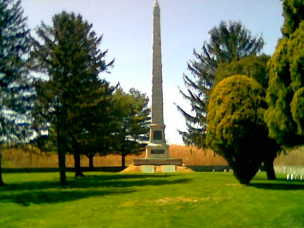
At the foot of
 the Delaware Memorial Bridge in New Jersey, next to Fort Mott State Park, lies Finn's Point National Cemetery, which contains the mass grave for some 2,500 Confederate POWs who died while incarcerated at at Ft. Delaware prison on Peach Pit Island during the Civil War. The prison held some 12,000 rebels. It is a sobering site, marked by a large obelisk erected in 1910 over plaques listing two thousand four hundred thirty-six names. There is also a small memorial to Union soldiers who died while on duty as guards, and a special section in a corner for a small number of
  German POWs who died while in custody at Fort Dix during World War II.
Finn's Point National Cemetery can be reached via I-295, on New Jersey State Road 49 towards Pennsville, NJ, located just before the beginning of the New Jersey Turnpike. Ft. Mott State Park is part of the New Jersey Coastal Heritage Trail, a new National Park.
Some stanzas from Theodore O'Hara's poem, The Bivouac of the Dead, are posted on cast-iron tablets near the obelisk:
The muffled drum's sad roll has beat
The soldier's last tattoo;
No more on life's parade shall meet
That brave and fallen few.
On Fame's eternal camping-ground
Their silent tents are spread,
And Glory guards, with solemn round,
The bivouac of the dead.
No rumor of the foe's advance
Now swells upon the wind;
Nor troubled thought at midnight haunts
Of loved ones left behind;
No vision of the morrow's strife
The warrior's dream alarms;
No braying horn nor screaming fife
At dawn shall call to arms.
Their shriveled swords are red with rust,
Their plumed heads are bowed,
Their haughty banner, trailed in dust,
Is now their martial shroud.
And plenteous funeral tears have washed
The red stains from each brow,
And the proud forms, by battle gashed
Are free from anguish now.
The neighing troop, the flashing blade,
The bugle's stirring blast,
The charge, the dreadful cannonade,
The din and shout, are past;
Nor war's wild note nor glory's peal
Shall thrill with fierce delight
Those breasts that nevermore may feel
The rapture of the fight.
Monday, April 17, 2006
Sunday, April 16, 2006


How Stalin Created Israel
 It wasn't Harry Truman alone who supported the creation of Israel.Johnson's Russia List's Research and Analytical Supplement runs Stephen D. Shenfield's interesting review of Leonid Mlechin's book, Zachem Stalin sozdal Izrail? [Why Did Stalin Create Israel?] (Moscow: Yauza / EKSMO, 2005):
 Did Stalin create Israel? To the extent that any one individual can be held responsible for the creation of a state, it does seem, on the basis of the evidence presented by Mlechin, that Stalin has a better claim than any other individual to this particular honor. Why did he do it? Apparently it was a gamble in the context of the more assertive Soviet foreign policy that followed victory over Nazi Germany, made in the hope of establishing a lasting Soviet presence in the Middle East. It failed, but it can be seen as a precursor of similar and more successful efforts in the post-Stalin era, this time backing the other side in the Israel-Arab conflict. It does show that the standard view of Soviet penetration of the Third World as a post-Stalin development is not quite accurate.
The episode also helps us fill in a broad historical view of the nature of Zionism-Israel as an international phenomenon. What made possible the remarkable rise of the Zionist community from a small and vulnerable minority in Ottoman-ruled Palestine at the beginning of the 20th century to a nuclear-armed regional superpower in that century's last quarter? Many things, to be sure. The Holocaust had a decisive impact. But we should not underplay the significance of the Zionist movement's ideologically flexible and repeatedly successful search for great power patrons. As the relationship with one patron becomes less viable, a new patron is always found:
1. Britain with the Balfour Declaration of 1917, whose Mandate provided a roof for building an autonomous quasi-state (the Yishuv).
2. Stalin's Soviet Union played the crucial role in the creation and initial consolidation of an independent Zionist state.
3. France gave Israel nuclear weapons.
4. US support was crucial in creating a Greater Israel.
5. Next great power patron -- China, perhaps?
Rev. Willaim Sloane Coffin, R.I.P.
 The death of Rev. William Sloane Coffin reminded me of the time he did me a favor. I was trying to put on a panel about the plight of Vietnamese "Boat People" and Cambodian refugees during the Carter administration. A lot of antiwar activists didn't want to help (at that time I was a liberal Democrat). It was getting depressing to be turned down again and again looking for help from places like The Nation. I remember Emile de Antonio telling me they (the Vietnamese & Cambodians) chose the wrong side (with the US) and so deserved to drown.
Well, in the end Martin Peretz of the New Republic agreed to pay for the event, and Rev. Coffin offered a room in Riverside Church. Coffin's participation helped fill the panel with experts like Frances Fitzgerald. The event was a big success, the room was full. And it helped change the Carter administration's policy towards refugees,many of whom who were admitted to the US.
I was touched.
No matter what I may have had by way of disagreements with some of his views, because of this I'll always remember William Sloane Coffin as a mensch. May he rest in peace.
Saturday, April 15, 2006
Read President Bush and Vice President Cheney's Tax Returns
You can download PDF versions of Bush and Cheney's IRS Form 1040s on the Tax History Foundation website. President Bush declared $397,000 in wages, tips, etc. Cheney declared $7, 423,433.
Tax Day Tips from the US Postal Service
In case you need to find the location of the closest Post Office.
The Wall Street Journal on Zacarias Moussaoui
The Wall Street Journal explains why the Moussaoui case is important
The further we move away from 9/11 without another domestic attack, the more tempting it is to believe that awful day was an aberration, to think that we can return to normalcy if we merely leave Iraq and the other Middle Eastern regimes to their own purposes. But the forces of radical Islam aren't going to leave us alone merely because we decide that resisting them is too hard. The men and women on that plane weren't soldiers overseas; they were traveling to work, or on vacation, or to their homes within the United States.There's more detail about the case on the BBC News website devoted to it, including this quote:
The main political difference in the U.S. today is between those who appreciate that Islamic terrorists represent an existential threat to American life and liberty and are prepared to do what it takes to defeat them, and those who think the threat is overstated and can be ameliorated or appeased. Only yesterday, al Qaeda kingpin Ayman al-Zawahiri exulted in a videotape posted on the Internet that "the enemy has begun to falter." He's wrong, but the transcript of Flight 93 is a reminder of our fate if we do.
Moussaoui took the stand against his lawyers' advice on the opening day of their defence.
He gave a lengthy explanation about why he hates Americans, and criticised US support for Israel.
"You are the head of the snake for me. If we want to destroy the Jewish state of Palestine, we have to destroy you first," he told the court.
He turned to the Koran for evidence he said backed up his claims that Muslims are called to fight for supremacy for Allah.
"We have to be the superpower, we have to be above you," he said.
Friday, April 14, 2006
The Story of Easter
From the US Naval Observatory:
Easter is an annual festival observed throughout the Christian world. The date for Easter shifts every year within the Gregorian Calendar. The Gregorian Calendar is the standard international calendar for civil use. In addition, it regulates the ceremonial cycle of the Roman Catholic and Protestant churches. The current Gregorian ecclesiastical rules that determine the date of Easter trace back to 325 CE at the First Council of Nicaea convened by the Roman Emperor Constantine. At that time the Roman world used the Julian Calendar (put in place by Julius Caesar).
The Council decided to keep Easter on a Sunday, the same Sunday throughout the world. To fix incontrovertibly the date for Easter, and to make it determinable indefinitely in advance, the Council constructed special tables to compute the date. These tables were revised in the following few centuries resulting eventually in the tables constructed by the 6th century Abbot of Scythia, Dionysis Exiguus. Nonetheless, different means of calculations continued in use throughout the Christian world.
In 1582 Gregory XIII (Pope of the Roman Catholic Church) completed a reconstruction of the Julian calendar and produced new Easter tables. One major difference between the Julian and Gregorian Calendar is the "leap year rule". See our FAQ on Calendars for a description of the difference. Universal adoption of this Gregorian calendar occurred slowly. By the 1700's, though, most of western Europe had adopted the Gregorian Calendar. The Eastern Christian churches still determine the Easter dates using the older Julian Calendar method.

Mutiny at the Pentagon
 What does a widely-reported insurgency, by retired Major General Paul D. Eaton, General Anthony C. Zinni, Lieutenant General Gregory Newbold, Major General John Batiste, Major General John Riggs and Major General Charles H. Swannack Jr., demanding that Donald Rumsfeld resign as Secretary of Defense, mean?
One guess is that the military is uncomfortable about the prospect of launching a war against Iran under Donald Rumsfeld. Retired officers are able to voice public criticisms that serving military are unable to put forward. Jim Lehrer interviewed retired General John Batiste on the Newshour last night
So far, the White House has dismissed the revolt of the generals:
JIM LEHRER: So where do you fit Don Rumsfeld into that then? He's one person. Everybody wants him to -- you guys want him to go. So what are you saying to me?
MAJ. GEN. JOHN BATISTE: I think an honorable man would take account, be responsible for what he did, and step down.
JIM LEHRER: What would you say to a skeptic who would say, "Wait a minute, General. One secretary of defense is solely responsible for everything that's gone wrong in Iraq, and there is nothing that any of you military leaders could do about it on the ground?"
MAJ. GEN. JOHN BATISTE: I didn't say that. What I'm saying is that the strategic underpinnings of this war can be traced back in policy to the secretary of defense. He built it the way he wanted it.
JIM LEHRER: Do you expect Secretary Rumsfeld to do what you want him to do?
MAJ. GEN. JOHN BATISTE: I have no idea.
JIM LEHRER: I mean, do you...
MAJ. GEN. JOHN BATISTE: He's his own man.
JIM LEHRER: Is that a bottom line for you? Have you talked to these other generals about this? Is this an organized effort?
MAJ. GEN. JOHN BATISTE: You know, surprisingly, it's not, not at all. We haven't talked; this is all spontaneous.
JIM LEHRER: Did you talk about it at the time when you were on active duty in private?
MAJ. GEN. JOHN BATISTE: Sure. We were all disgruntled.
SCOTT MCCLELLAN, White House Press Secretary: The president believes Secretary Rumsfeld is doing a very fine job during a challenging period in our nation's history.Translation: "Heck of a job, Rummy..."
Thursday, April 13, 2006
Iraqi Claims Saddam Gave WMD to Syria
Melanie Phillips reports on former Iraqi Air Vice Marshal General Georges Sada's charges (ht LGF):
He also says that he lived and worked with the ever-present daily reality of Saddam’s tactics of hiding his WMD from the weapons inspectors. Whole environments were transformed and rebuilt – buildings, whole factories – in the largely successful strategy of hiding the stuff. The idea that Saddam suddenly stopped hiding it and secretly destroyed it instead, he says, is utterly ludicrous. Hiding WMD was the unchanging pattern of his regime.
He has listened to the tapes that recently surfaced of Saddam’s discussions with his top brass about the problems being caused by the UN weapons inspectors. He says the translations that have so far been made of these tapes are inadequate because the translators, who are of course Arabic speakers, do not however speak Tikriti Arabic, the dialect in which these discussions were conducted. Sada does speak Tikriti. He has translated a crucial three and a half minutes of these tapes, he says, in which Saddam and his generals are discussing how to outwit the UN inspectors; in which they say that the problem of the chemical weapons is solved but the biological are still causing a problem; that this problem will probably be solved with the help of the Russians and the French; and in which Saddam says: ‘In the future the terrorism will be with WMD’.
In April 2004, a group of al Qaeda terrorists was caught in Jordan with 20 tons of Sarin gas. When Sada heard of this, he says, his blood ran cold. There was only one place which was capable of producing 20 tons of Sarin: Saddam’s Iraq. To his horror, he says, he realised at that moment that Saddam’s WMD had got into the hands of al Qaeda.
Subscribe to:
Posts (Atom)