Jyllands-Posten reporter Anders Raahauge was very helpful in getting us up to speed with the Muhammad cartoons story early on. I asked Anders for his comments from the center of the storm, about how things look from Denmark and the Jyllands-Posten now that the Muhammad cartoons story has evolved into a hurricane.
Hi Daryl
Well, apart from the major events, that you now finally get from the (news) agencies (latest is the embassy-fire in Damascus, with Syrian police not protecting the building), I can tell about the climate: the most liberal-left wing Danes can understand the Muslim reaction (suffering discrimination for so long etc.). Industry owners are wringing their hands about the trade-boykott, urging for apologies, they also - well some of them, (and) other "capitalists," stand tall and declare that any bill should be paid without whimpering; some principles are too dear to be sold out. And apart from that, they hold (that) the situation is like negotiating with terrorists who take hostages -you'll never see the end of it but only (see) new demands. So one may as well decline any surrender from the outset.
And the many Danes? Well, judging from the letters to the newspapers, the vast majority take this second stance. Enough is enough. We won't be dictated (to about ) How to behave in our own country; we are not going to settle things like they do in the Middle East-dictatorships ... Of course some Danes are pretty anxious, terror threats have been launched, but the mood is predominantly defiant, and people consider the case an eye-opener.
Your poor colleagues though: In London the demonstrators now emphazise that there is no reason to apologize, it is not required, and it won't make any difference. The 12 cartoonists just must be executed - by us or else they can fix it (themselves), preferably (by) beheading, they explain. And that can, as in the case of Rushdie, be sooner or later; perhaps in ten years time. Will the cartoonists ever get their lives back? ...
best
Anders
Saturday, February 04, 2006
Daryl Cagle on the Danish Cartoon Crisis
Reaction from working cartoonists can be found on Daryl Cagle's Professional Cartoonists Index. He even has a letter from the editor of the Danish newspaper at the center of this storm:


Roger Kimball on the Danish Cartoon Crisis
He quotes from The Belmont Club's analysis in The New Criterion.
There's also interesting stuff at Sisu
There's also interesting stuff at Sisu
Ibn Warraq: Do Not Apologize
Just Observing quotes advice on how to handle the Danish Cartoon crisis, from a leading anti-Islamist in the Middle East:
A democracy cannot survive long without freedom of expression, the freedom to argue, to dissent, even to insult and offend. It is a freedom sorely lacking in the Islamic world, and without it Islam will remain unassailed in its dogmatic, fanatical, medieval fortress; ossified, totalitarian and intolerant. Without this fundamental freedom, Islam will continue to stifle thought, human rights, individuality; originality and truth.Unless, we show some solidarity, unashamed, noisy, public solidarity with the Danish cartoonists, then the forces that are trying to impose on the Free West a totalitarian ideology will have won; the Islamization of Europe will have begun in earnest. Do not apologize.
Charles Moore: Face Down Cartoon Terror Campaign
Writing in the Telegraph, Charles Moore points out that Jack Straw and Sean McCormack simply don't know the history of Muslim attitudes towards pictures of the Prophet:
There is no reason to doubt that Muslims worry very much about depictions of Mohammed. Like many, chiefly Protestant, Christians, they fear idolatry. But, as I write, I have beside me a learned book about Islamic art and architecture which shows numerous Muslim paintings from Turkey, Persia, Arabia and so on. These depict the Prophet preaching, having visions, being fed by his wet nurse, going on his Night-Journey to heaven, etc. The truth is that in Islam, as in Christianity, not everyone agrees about what is permissible.
Some of these depictions are in Western museums. What will the authorities do if the puritan factions within Islam start calling for them to be removed from display (this call has been made, by the way, about a medieval Christian depiction of the Prophet in Bologna)? Will their feeling of "offence" outweigh the rights of everyone else?
Obviously, in the case of the Danish pictures, there was no danger of idolatry, since the pictures were unflattering. The problem, rather, was insult. But I am a bit confused about why someone like Qaradawi thinks it is insulting to show the Prophet's turban turned into a bomb, as one of the cartoons does. He never stops telling us that Islam commands its followers to blow other people up.
If we take fright whenever extreme Muslims complain, we put more power in their hands. If the Religious Hatred Bill had passed unamended this week, it would have been an open invitation to any Muslim who likes getting angry to try to back his anger with the force of law. Even in its emasculated state, the Bill will still encourage him, thus stirring the ill-feeling its authors say they want to suppress.
On the Today programme yesterday, Stewart Lee, author of Jerry Springer: The Opera - in which Jesus appears wearing nappies - let the cat out of the bag. He suggested that it was fine to offend Christians because they had themselves degraded their iconography; Islam, however, has always been more "conscientious about protecting the brand".
The implication of the remark is fascinating. It is that the only people whose feelings artists, newspapers and so on should consider are those who protest violently. The fact that Christians nowadays do not threaten to blow up art galleries, invade television studios or kill writers and producers does not mean that their tolerance is rewarded by politeness. It means that they are insulted the more.
Right now, at the fashionable White Cube Gallery in Hoxton, you can see the latest work of Gilbert and George, mainly devoted, it is reported, to attacks on the Catholic Church. The show is called Sonofagod Pictures and it features the head of Christ on the Cross replaced with that of a primitive deity. One picture includes the slogan "God loves F***ing".
Like most Christians, I find this offensive, but I think I must live with the offence in the interests of freedom. If I find, however, that people who threaten violence do have the power to suppress what they dislike, why should I bother to defend freedom any more? Why shouldn't I ring up the Hon Jay Jopling, the proprietor, and tell him that I shall burn down the White Cube Gallery unless he tears Gilbert and George off the walls? I won't, I promise, but how much longer before some Christians do? The Islamist example shows that it works.
There is a great deal of talk about responsible journalism, gratuitous offence, multicultural sensitivities and so on. Jack Straw gibbers about the irresponsibility of the cartoons, but says nothing against the Muslims threatening death in response to them. I wish someone would mention the word that dominates Western culture in the face of militant Islam - fear. And then I wish someone would face it down.
Indigo Lake on Danish Cartoon Crisis
Jen's blog points out that blasphemy is everywhere in the US (not just in South Park), for example: Rock the Casbah is offensive to Islam.
So, Sean McCormack, Condoleeza Rice, and George Bush, fasten your seatbelts--it's going to be a bumpy ride...
So, Sean McCormack, Condoleeza Rice, and George Bush, fasten your seatbelts--it's going to be a bumpy ride...
Andrew Sullivan: Media Lie About Danish Cartoons
Andrew Sullivantells it like it is:
The Lie
One meme that deserves to be nipped in the bud is that the original Danish cartoons were somehow intended purely for offense. Since most American papers and magazines will not publish the cartoons, many people might actually believe this. In fact the context of the publication reveals a much more important point. From Wikipedia's summary:
The drawings, which include a depiction of Muhammad with a bomb in his turban, were meant as satirical illustrations accompanying an article on self-censorship and freedom of speech. Jyllands-Posten commissioned and published the cartoons in response to the difficulty of Danish writer Kåre Bluitgen to find artists to illustrate his children's book about Muhammad, for fear of violent attacks by extremist Muslims.
The point was to expose the bullying of Islamists. And boy, have the cartoons succeeded.
Michelle Malkin on Danish Cartoon Crisis
Her Washington Times column is directly on target in its explanation of why a Danish newspaper printed cartoons of Mohammed:
The newspaper was making a vivid editorial point about European artists' fear of retaliation for drawing any pictures of Muhammad at all. (Remember: It's been little more than a year since Dutch filmmaker Theo van Gogh was murdered by an Islamist gunman over his movie criticizing violence against women in Islamic societies.)She has more photos on her blog, http://www.michellemalkin.com.
A Danish author had reported last fall he couldn't find an illustrator for a book about Muhammad; the Jyllands-Posten editors rose to the challenge by calling on artists to send in their submissions and publishing the 12 entries received.
The reaction to the cartoons resoundingly confirmed fears those artists expressed about radical Islamic intolerance and violence. The Jyllands-Posten reported two illustrators received death threats and went into hiding. The Pakistani Jamaaat-e-Islami Party put a 5,000-kroner bounty on the cartoonists' heads. A terrorist outfit called the "Glory Brigades" threatened suicide bombings in Denmark over the artwork.
Despite how relatively tame the pictures actually are (compared not only to Western standards, but also to the vicious, anti-Semitic propaganda regularly churned out by Arab cartoonists), the drawings have literally inflamed the radical Muslim world and its apologists...First, they came for the cartoonists. Then, they came for the filmmakers and talk show hosts and namers of evil. Next, who knows?
More Forbidden Images of Mohammed...
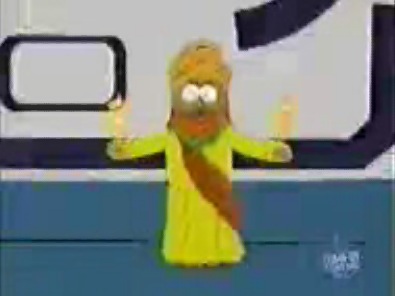 ...like this one from South Park, can be found on The Religious Policeman's website.
NY Times: We Won't Print Danish Cartoons
Well at least we know whose side people are on.
The NY Times, Boston Globe, Washington Post, and Los Angeles Times, among other papers, published photos of "Piss Christ." At the time of the NEA controvery, their editorials denounced Christian fundamentalists. Today, they side with Islamist fundamentalists.
Here's Joel Brinkley's apologia in the New York Times:
The NY Times, Boston Globe, Washington Post, and Los Angeles Times, among other papers, published photos of "Piss Christ." At the time of the NEA controvery, their editorials denounced Christian fundamentalists. Today, they side with Islamist fundamentalists.
Here's Joel Brinkley's apologia in the New York Times:
Major American newspapers, including The New York Times, The Washington Post, The Los Angeles Times and The Chicago Tribune, did not publish the caricatures. Representatives said the story could be told effectively without publishing images that many would find offensive.Kudos to Brit Hume for showing the pictures on his Fox News show, shame on CNN for pixillating them. If I hadn't already cancelled my NY Times subscription a few years ago, I'd cancel it now.
"Readers were well served by a short story without publishing the cartoon," said Robert Christie, a spokesman for Dow Jones & Company, which owns The Wall Street Journal. "We didn't want to publish anything that can be perceived as inflammatory to our readers' culture when it didn't add anything to the story."
In a midafternoon meeting on Friday, editors at The Chicago Tribune discussed the issue but decided against publishing the cartoons. "We can communicate to our readers what this is about without running it," said James O'Shea, the paper's managing editor.
Ayaan Hirsi Ali on Danish Cartoon Crisis
Theo van Gogh's collaborator posts these and other photos of posters from recent anti-Danish demonstrations on her website. She takes these threats very seriously...


US State Department Q&A on Danish Cartoons
From Little Green Footballs:
QUESTION: Yes? Can you say anything about a U.S. response or a U.S. reaction to this uproar in Europe over the Prophet Muhammad pictures? Do you have any reaction to it? Are you concerned that the violence is going to spread and make everything just —
MR. MCCORMACK: I haven’t seen any — first of all, this is matter of fact. I haven’t seen it. I have seen a lot of protests. I’ve seen a great deal of distress expressed by Muslims across the globe. The Muslims around the world have expressed the fact that they are outraged and that they take great offense at the images that were printed in the Danish newspaper, as well as in other newspapers around the world.
Our response is to say that while we certainly don’t agree with, support, or in some cases, we condemn the views that are aired in public that are published in media organizations around the world, we, at the same time, defend the right of those individuals to express their views. For us, freedom of expression is at the core of our democracy and it is something that we have shed blood and treasure around the world to defend and we will continue to do so. That said, there are other aspects to democracy, our democracy — democracies around the world — and that is to promote understanding, to promote respect for minority rights, to try to appreciate the differences that may exist among us.
We believe, for example in our country, that people from different religious backgrounds, ethnic backgrounds, national backgrounds add to our strength as a country. And it is important to recognize and appreciate those differences. And it is also important to protect the rights of individuals and the media to express a point of view concerning various subjects. So while we share the offense that Muslims have taken at these images, we at the same time vigorously defend the right of individuals to express points of view. We may — like I said, we may not agree with those points of view, we may condemn those points of view but we respect and emphasize the importance that those individuals have the right to express those points of view.
For example — and on the particular cartoon that was published — I know the Prime Minister of Denmark has talked about his, I know that the newspaper that originally printed it has apologized, so they have addressed this particular issue. So we would urge all parties to exercise the maximum degree of understanding, the maximum degree of tolerance when they talk about this issue. And we would urge dialogue, not violence. And that also those that might take offense at these images that have been published, when they see similar views or images that could be perceived as anti-Semitic or anti-Catholic, that they speak out with equal vigor against those images.
QUESTION: That the Muslims speak out with equal vigor when they see — that’s what you’re asking?
MR. MCCORMACK: We would — we believe that it is an important principle that peoples around the world encourage dialogue, not violence; dialogue, not misunderstanding and that when you see an image that is offensive to another particular group, to speak out against that. Anti-Muslim images are as unacceptable as anti-Semitic images, as anti-Christian images or any other religious belief. We have to remember and respect the deeply held beliefs of those who have different beliefs from us. But it is important that we also support the rights of individuals to express their freely held views.
QUESTION: So basically you’re just hoping that it doesn’t — I’m sorry I misspoke when I said there was violence, I meant uproar. Your bottom line is that both sides have the right to do exactly as they’re doing and you just hope it doesn’t get worse?
MR. MCCORMACK: Well, I —
QUESTION: You just hope it doesn’t escalate.
MR. MCCORMACK: I gave a pretty long answer, so —
QUESTION: You did. I’m trying to sum it up for you. (Laughter.)
MR. MCCORMACK: Yeah. Sure.
QUESTION: A couple of years ago, I think it was a couple of years ago when, I think it was the Syrians and the Lebanese were introducing this documentary about the Jews — or it was the Egyptians — this Administration spoke out very strongly about that and called it offensive, said it was —
MR. MCCORMACK: I just said that the images were offensive; we found them offensive.
QUESTION: Well, no you said that you understand that the Muslims found them offensive, but —
MR. MCCORMACK: I’m saying now, we find them offensive. And we certainly understand why Muslims would find these images offensive.
Yes.
QUESTION: One word is puzzling me in this, Sean, and that’s the use of the word “unacceptable” and “not acceptable,” exactly what that implies. I mean, it’s not quite obvious that you find the images offensive. When you say “unacceptable,” it applies some sort of action against the people who perpetrate those images.
MR. MCCORMACK: No. I think I made it very clear that our defense of freedom of expression and the ability of individuals and media organizations to engage in free expression is forthright and it is strong, you know. This is — our First Amendment rights, the freedom of expression, are some of the most strongly held and dearly held views that we have here in America. And certainly nothing that I said, I would hope, would imply any diminution of that support.
QUESTION: It’s just the one word “unacceptable,” I’m just wondering if that implied any action, you know. But it doesn’t you say?
MR. MCCORMACK: No.
QUESTION: Okay.
MR. MCCORMACK: Yes.
Danish Cartoonists Go Into Hiding
According to The Times of London, Danish cartoonists have gone into hiding, afraid for their lives as a result of the international agitation against their published cartoons of Mohammed.
Strangely, I didn't hear any condemnations of the threats from Britain's Jack Straw or US State Department Sean McCormack.
Margaret Thatcher, on the other hand, stood up to terror and offered Salman Rushdie full-time police protection. She remembered what Bush and Blair have forgotten: Appeasement breeds aggression.
Strangely, I didn't hear any condemnations of the threats from Britain's Jack Straw or US State Department Sean McCormack.
Margaret Thatcher, on the other hand, stood up to terror and offered Salman Rushdie full-time police protection. She remembered what Bush and Blair have forgotten: Appeasement breeds aggression.
Friday, February 03, 2006
Roger L Simon on Denmark
From Astute Blogger:
WHERE'S THE OUTRAGE .... on the part of artists and writers!?
Has the WGA or PEN (or any other artists' or writers' organizations) voiced ANY support for the Denmark?
NOPE. They are as silent about this afront to freedom of expression as they were about the murder of Theo van Gogh. They SHOULD be as supportive to Denmark as the dozen or so European newspaper which have reprinted the cartoons in a fabulous display of solidarity with Denmark.
This blogger happens to be a former official of the WGA and PEN. That they are both silent on this issue does not suprise me in the slightest. Much of their membership is probably not even aware of it.
Clash of Civilizations Continues
Ghe Financial Times says rage against Denmark is still spreading:
Angry protests over newspaper cartoons of the prophet Mohammad continued to spread globally on Friday as Muslim leaders and politicians in Europe expressed mounting concern that the outrage could destabilise the multicultural continent.
In Indonesia, the world’s largest Muslim nation, protesters stormed the lobby of the Jakarta high-rise building housing the Danish embassy. Other incidents and protests were reported from Pakistan to the Darfur region of Sudan and the Palestinian territories, where European Union observers evacuated Danish and French nationals after gunmen had briefly held a German man in the West Bank on Thursday night.
In London, hundreds of Muslims marched from the Regent's Park mosque, one of the biggest Islamic centres in Europe, to the heavily protected Danish embassy, bearing placards declaring “Behead the one who insults the prophet” and “Free speech go to hell”.
The most serious religious clash since the 1989 Salman Rushdie affair erupted last September when Denmark’s Jyllands-Posten published 12 caricatures of Mohammad, the seventh-century founder of Islam, in protest at what it called “the rejection of modern, secular society” by some Muslims.
The debate only boiled over last month when European newspapers began reprinting the cartoons, considered blasphemous by many Muslims, sparking a fresh wave of protests in the Muslim world, including boycotts of Danish products and the recalling of ambassadors to Copenhagen.
Islamik Trossamfund, a small Danish Muslim organisation, has been accused of throwing petrol on the fire after its leaders toured the Middle-East circulating highly offensive pictures of Muslims that had never appeared in the Danish press.
Support Denmark.com
 It's the pen v. the sword; bloggers and writers v. mobs and their fanatic leaders; free speech v. submission.
 Denmark's supporters are rushing to their electronic pens, as one can see at websites like Support Denmark.com.
Palestinians Rage Against Denmark
Reuters reports from the Palestinian Authority:
"Whoever defames our prophet should be executed," said Ismail Hassan, 37, a tailor who marched through the pouring rain along with hundreds of others in the West Bank city of Ramallah.
"Bin Laden our beloved, Denmark must be blown up," protesters in Ramallah chanted.
In mosques throughout Palestinian cities, clerics condemned the cartoons. An imam at the Omari Mosque in Gaza City told 9,000 worshippers that those behind the drawings should have their heads cut off.
"If they want a war of religions, we are ready," Hassan Sharaf, an imam in Nablus, said in his sermon.
About 10,000 demonstrators, including gunmen from the Islamic militant group Hamas firing in the air, marched through Gaza City to the Palestinian legislature, where they climbed on the roof, waving green Hamas banners.
"We are ready to redeem you with our souls and our blood our beloved prophet," they chanted. "Down, Down Denmark."
Will Danish Cartoons Spark World War III?
The BBC is reporting here and here and in a reader's forum here a worldwide "clash of civilizations" over those famous Danish cartoons of Mohammed.
Could this really spark World War III? It seems hard to believe that matters will get so out of hand--yet one remembers that a simple visit by Ariel Sharon to Jerusalem's Temple Mount sparked the Palestinian Intifada; the National Endowment for the Arts' funding of "Piss Christ" led to a Republican takeover of the US Congress; and Paris's kidnapping of Helen of Troy led to the Trojan War-- as well as a line that seems appropriate in relation to the Danish cartoon crisis:
"Is this the face that launched a thousand ships?"
Little Green Footballs has a slideshow of the cartoons, here. Bigger than what we posted below, and makes clear that they are not very nasty, as Andrew Sullivan described them, "tame" by American standards.
For another historical reference, see Voltaire's play Le fanatisme, ou Mahomet le prophète. Background on a banned Geneva revival, here.
More about today's calls to war at Little Green Footballs.
Human Events has posted a cartoon gallery here.
Financial Times story here.
Telegraph stories here and here.
More reason to like Sarkozy:
Could this really spark World War III? It seems hard to believe that matters will get so out of hand--yet one remembers that a simple visit by Ariel Sharon to Jerusalem's Temple Mount sparked the Palestinian Intifada; the National Endowment for the Arts' funding of "Piss Christ" led to a Republican takeover of the US Congress; and Paris's kidnapping of Helen of Troy led to the Trojan War-- as well as a line that seems appropriate in relation to the Danish cartoon crisis:
"Is this the face that launched a thousand ships?"
Little Green Footballs has a slideshow of the cartoons, here. Bigger than what we posted below, and makes clear that they are not very nasty, as Andrew Sullivan described them, "tame" by American standards.
For another historical reference, see Voltaire's play Le fanatisme, ou Mahomet le prophète. Background on a banned Geneva revival, here.
More about today's calls to war at Little Green Footballs.
Human Events has posted a cartoon gallery here.
Financial Times story here.
Telegraph stories here and here.
More reason to like Sarkozy:
This from the Guardian: But not everyone was acquiescent. France's interior minister, Nicolas Sarkozy, said he preferred "an excess of caricature to an excess of censure".
Wednesday, February 01, 2006
African American Lives
I just loved watching this Henry Louis Gates PBS show tonight, part detective story, part science program, part inspirational saga, part history, part autobiography of Henry Louis Gates, Jr. I am happy that PBS made it, every segment is interesting in a different way. Congratulations to everyone involved in a wonderful television series that has so many different levels that it is hard to talk about.
Putin Meets the Press
 Meanwhile, back in the Kremlin, Vladimir Vladimirovich Putin held a 3-hour press conference. You can read the full transcript here. Of particular interest to me was his answer to a question about Uzbekistan:
STEVEN GUTTERMAN (correspondent for the Associated Press, USA): During your presidency you said that Russia is a European country that shares European culture and values. But sometimes Russia supports certain opinions or a certain regime in the former Soviet Union which obviously does not share these values. For example, events in Andizhan and Russian support for Uzbekistan's actions during these events. Do you not think that these approaches are incompatible?Also interesting was Putin's analysis of the Hamas victory in Palestinian elections:
Thank you.
VLADIMIR PUTIN: I do not think that these approaches are incompatible, especially since we know better than you do what happened in Andizhan. And we know who trained the people who ignited the situation in Uzbekistan and in that city in particular, where they were trained, and how many of them were trained. This does not exclude the fact that there are a great many problems in Uzbekistan, but it does exclude the fact that we take an approach in which we oscillate, or in which we could allow ourselves to shake up the situation in that country.
You probably know what the Fergana valley is and you know how difficult the situation is there, the population's situation and their level of economic well-being. We do not need a second Afghanistan in Central Asian and we shall proceed very carefully. We do not need revolutions there, we need an evolution which will lead to establishing those values you spoke about, but that will not encourage explosions like the ones we faced in Andizhan.
MOHAMMED AMRO (Al-Jazeera): Mr President!Of course, he spoke about the Russian-Ukranian gas showdown:
After Hamas' victory in the Middle East there have been certain statements from the west threatening to stop or diminish the help they give the Palestinian population.
Will your position on this issue change? And do you agree with the opinion that what is happening now in the Middle East is the failure of American diplomacy?
Thank you.
VLADIMIR PUTIN: It is a big setback, an important setback for American efforts in the Middle East. A very serious setback.
I think that if we want to resolve these difficult global problems than we must only do so together and not invite the participants in the process to pull the chestnuts out of the fire, but rather sit down together and to listen to each other right from the beginning and to take corresponding decisions.
Our position concerning Hamas differs from the American and western European positions. The foreign ministry of the Russian Federation never declared that Hamas is a terrorist organization. But this does not mean that we approve and support everything that Hamas does and all the declarations that they have made recently. We think that it is one thing when this political force was the opposition and trying to get into power and we know that throughout the whole world very often the opposition makes very radical statements. It is another thing when it receives the people's vote of confidence and must make sure that the people who believed in this movement feel the positive results of their authorities' work. ves the people's vote of confidence and must make sure that the people who believed in this movement feel the positive results of their authorities' work. And for this it is necessary to leave behind the extremist positions, to recognize Israel's right to exist and to have relations with the international community.
We call on Hamas to do these things. In any case we would consider refusing to help the Palestinian people a mistake.
OLGA SOLOMONOVA (Trud newspaper): I have a question concerning Russian-Ukrainian relations in the gas sector.The most Russian moment seemed to be this exchange with a reporter who covers the Russian automobile industry and asked to test drive the President's car:
It seems that everything had been resolved at the beginning of this year, that you agreed on everything. You met personally with Yushchenko. Everything seemed normal.
Now, as is well-known, Ukraine is once again starting to take gas outright and Gazprom is constantly increasing deliveries to Europe.
What is your impression of this situation?
VLADIMIR PUTIN: First of all I consider very positive the fact that we were able to agree with Ukrainian leadership on a common approach towards supplying Ukraine with Russian energy. It is positive both for our bilateral relations and for the energy situation in Europe and in the world.
And I consider that Ukrainian leadership took a courageous and correct step when it accepted these agreements. These agreements were a compromise and each party is satisfied with them. Along with this, you are correct. We agreed on everything, signed everything regarding prices, fixing prices, the volumes of deliveries. And despite all of these agreements and without any conflicts, we were faced with the situation in which a large amount of Russian gas is being siphoned off from the pipelines through which it is exported to Europe. During a cold period in Ukraine this amounted to 34-35 million cubic metres of gas per day. Gazprom wanted to remake these losses for western European consumers and unilaterally increased daily deliveries by 35 million. What happened next? Our Ukrainian partners continued to take 35 million daily in addition to the supplementary amount that Gazprom was delivering, that is 70 million cubic metres a day.
And now I would like to ask a question to those sceptics who didn't believe it was necessary to construct the Northern European Gas Pipeline under the Baltic Sea. Is this pipeline necessary to ensure a stable gas supply to western Europe or not? Whoever talks about this theme in the future must reflect on whose interests they have at heart, the interests of their own population or other interests that are difficult to justify.
We expect that we shall be able to find an equilibrium in our relations with our Ukrainian partners. I am happy about the fact that, in contrast to previous years, our Ukrainian partners said straight out that they were taking this gas, there was no tentative to cover up, nor to distort the fact. It is important to us that we are paid for this gas according to the prices we agreed on. This can be done either at the end of February or in another way, seeing as the quantity of gas delivered to Ukraine, the quantity of Russian gas, is limited to 17 billion cubic metres a year. This means that at one point the total volume shall be determined and then we must agree on the new volume. But it is important that this is not hidden but discussed openly. I hope that these discussions will lead to a positive result.
FEDOR BYSTROV (Volga Press): ...And I have a second question if you do not consider it out of place: would it be possible to use your private car for a test drive? I think that many Russians would be interested to know what is in the President's car.
Well, using this opportunity, I would like to invite you to drive in a Togliatti.
VLADIMIR PUTIN: Thank you, thank you for the invitation.
Which car would you like to receive? (excitement in the room)
FEDOR. BYSTROV: A Volga.
VLADIMIR PUTIN: A Volga?
FEDOR BYSTROV: Yes, I would like to do an article on a Volga.
VLADIMIR PUTIN: Okay, fine, we agreed.
Like Putin, I'm surprised any reporter wants to test-drive a Volga . . .

Subscribe to:
Posts (Atom)