Karl Rove is Bob Shrum with a good cause. (Shrum has run eight presidential campaigns; number won: 0, number lost: 8.) Bush calls Rove the "architect" of his 2004 victory. In 2004, America was at war and the Democrats ran a gigolo to be commander in chief. The nation hasn't changed so much since Reagan was president that the last election should have even been close.
Whenever the nation is threatened by external enemies, the only way Democrats can win a presidential election is with another Watergate. And yet Bush nearly lost the last election. He would have lost, but for the Swiftboat Veterans — also dissed by Bush.
Friday, September 30, 2005
Ann Coulter Doesn't Like Karl Rove


A Hillary Clinton-Geena Davis Connection
Exposed by John Fund in today's Wall Street Journal:
Wonder if this will lead to a campaign-finance investigation? After all, if this show is so much fun--it's probably illegal...
After the Washington premiere, Steve Cohen, a writer for the series who was Mrs. Clinton's deputy White House communications director, was mobbed by the senator's fans.
Wonder if this will lead to a campaign-finance investigation? After all, if this show is so much fun--it's probably illegal...
Sprung Miller Sings
Why is Judy Miller's testimony before the grand jury today important?
This paragraph from today's AP story tells:
It is doubtful that Libby did anything without Dick Cheney's knowledge or permission...
This paragraph from today's AP story tells:
Until a few months ago, the White House maintained for nearly two years that Libby and presidential aide Karl Rove were not involved in leaking the identity of Valerie Plame, whose husband had publicly suggested that the Bush administration twisted intelligence in the runup to the war in Iraq.
It is doubtful that Libby did anything without Dick Cheney's knowledge or permission...
Thursday, September 29, 2005
Judge Orders Release of US Torture Photos
It's about time that we saw what the heck has been going on at Abu Gharib.
How can the US criticize any other country for human rights abuses, when we still haven't dealt with our own torture problem?
How can the US criticize any other country for human rights abuses, when we still haven't dealt with our own torture problem?
FBI Kills 72 Year Old Puerto Rican Suspect
This story is probably not going to help Karen Hughes' efforts to improve America's international image:
And America condemns other countries for human rights violations?
The gunfight, which left longtime fugitive Filiberto Ojeda Rios dead and an FBI agent severely wounded, has sparked allegations that the FBI shot Ojeda Rios, a Puerto Rican separatist leader, and refused to enter his farmhouse as he bled to death.
And America condemns other countries for human rights violations?
Is Bush a "Neo-Bolshevik?"
 According to Igor Torbakov's article for Eurasianet, Russian pundits say Bush's current democracy-spreading tactics owe something to the Comintern:
 Immediately after Bush announced the formation of the ARC, Russian political analysts expressed the belief that ARC’s operations would be aimed at post-Soviet states, and began comparing it to the Moscow-controlled Communist International, or Komintern, which promoted the spread of communism prior to the Second World War. Vyacheslav Nikonov, the Kremlin-connected head of the Politika Foundation think tank, asserted in a commentary published by the Trud daily that Bush’s vision for the ACR "doesn’t differ much from the Komintern’s policies." The methods, instruments and even slogans used by the Bolsheviks and those employed now by the Bush administration are basically the same, Nikonov wrote.
During the early Bolshevik era, the People’s Commissariat of Foreign Affairs sought to develop mutually beneficial relations with the world’s leading capitalist countries. At the same time, the Komintern carried out subversive activities in those same countries. For some Russian pundits, there’s a clear analogy between the Komintern’s tactics and present-day US foreign policy in the post-Soviet lands. On the one hand, they say, Washington seeks Russia’s help in the global war on terror, while on the other; US officials are keen to undermine Moscow’s strategic stature in its traditional sphere of influence.
Russian government officials have not publicly embraced or endorsed such "politically incorrect" comparisons. But they most likely share at least some of the Russian conservative pundits’ perspectives on US foreign policy. Russia’s Foreign Minister Sergei Lavrov, for example, recently reiterated that US attempts to "export democracy" to CIS countries and encourage "non-parliamentary methods of fighting" can lead to destabilization and new conflicts.
The Return

Thanks to our Netflix subscription, last night we watched Vozvrashcheniye (The Return) on DVD. Andrei Zvyagintsev's 2003 drama was memorable, and very Russian in feeling and mentality. Lots of suffering. Clearly allegorical. Good photography. Sad ending, made even sadder by the knowledge that actor Vladimir Garin drowned shortly after filming was completed.
American and British reviews via the IMDB link seemed to take the film as a story of a troubled father-son relationship, and a coming-of-age saga. Having lived in Russia, it seemed to me that the spare allegorical style probably was something more, something that Russians might understand at once, that I didn't quite get.
The plot is terribly simple. After a 12-year absence, a father returns to his family. He takes them on a fishing trip to a deserted island many miles from home. The natural landscape is beautiful, but the human one is not. The father digs up a buried treasure in an abandonded building. Trouble and tragedy follow. The end.
What did it mean?
None of the reviews mentioned it, but I wondered: Could the desert island have been one of the Solovetsky islands, location of the notorious Solovki prison camp the mother of the GULAG, according to Solzhenitsyn? Known as SLON, the Solovki prison camp was in use from 1923 to 1939. No one can say for sure exactly how many died.
Nowadays the location is a tourist site. Might the father in have been a returning prisoner who wanted to show his children where he had been, and what he had endured? Rebecca Santana's 2002 visit to the camp for the Voice of America seems to match the plot of the film. Beatings, arbitrary authority, left standing in the soaking rain, all take place in the father-son story--just as they did in the prison.
The boy is left soaking in the rain on a bridge over a canal. Could this be the infamous White Sea Canal, a slave labor project originally named after Stalin? Even the towers in the film remind one of prison watchtowers. And the events that take place are similar to those described in this account by Gregg Zoroya
Tour guide Olga Vostriakova says about Solovetsky: "Probably, this is a place where evil things and good things are connected together."
Nowhere is that more true than on Sekirnaya Hill, several miles north of the monastery. When the religious center was wealthy and flourishing in the 1800s, the Russian Orthodox monks built a two-story wooden chapel with a lighthouse in the tower on this highest point of land.
Today, the chapel survives, weathered and peaceful on a grassy summit where goats graze. But it is no longer a symbol of good tidings.
The Bolsheviks made it a punishment center for the gulag. Thugs who doubled as prison guards -- many of them criminals given greater authority than political prisoners -- practiced sadistic forms of torture. They would strip prisoners naked and stake them out where mosquitoes could feast. Or they would force prisoners to balance all day on horizontal poles running across the chapel at a level too high for feet to touch the ground. Those who fell were beaten or, worse, strapped lengthwise to a heavy beam and rolled down a steep portion of the hill, more than 200 feet to the bottom. It was a death sentence.
"The laws of the underworld became the camp standard," says the narrator of a 1988 Russian documentary, Solovki Power.
Would a former prisoner really return to visit the place of his incarceration? Santana's story suggests the answer is yes:
She recalls that one day a man came into her office and started looking around. When Ms. Shopkina asked if he needed help, he replied that he simply wanted to see the room where he lived as a prisoner.
Wednesday, September 28, 2005
Tony Blair's Labour Party Conference Speech
This is what he said about Iraq, Afghanistan, and the Global War on Terror. Not quite Shakespeare, but not too shabby:
Today, of course, we face a new challenge: global terrorism.
Let us state one thing.
These terrorists do not, never have and never will represent the decent, humane and principled faith of Islam.
Muslims, like all of us, abhor terrorism. Like all of us, are its victims.
It is, as ever, only fringe fanatics we face.
But we need to make it clear.
When people come to our country, they have and should have the full rights we believe in. There should be no second-class citizens in Britain. But citizenship comes with a duty: to give loyalty to our nation, its values and our way of life.
If people have a grievance, politics is the answer. Not terror.
Terrorism brings home to us this now obvious truth of the modern world. Nations, even the largest, need to work together for their common good.
Isolationism is as backward as protectionism. For a country the size of Britain, there is no securing our future without strong alliances.
When I became Prime Minister I took a decision: always be at the forefront where decisions are made not at the back where they’re handed down.
That is why at every point, no matter how difficult we remain strong partners in Europe. By all means let us fight for reform in Europe; but to isolate ourselves from the world’s largest commercial market in which over 50% of our trade is done, is just a crazy policy for Britain in the 21st century.
Britain should also remain the strongest ally of the United States. I know there’s a bit of us that would like me to do a Hugh Grant in Love Actually and tell America where to get off. But the difference between a good film and real life is that in real life there’s the next day, the next year, the next lifetime to contemplate the ruinous consequences of easy applause.
I never doubted after September 11th that our place was alongside America and I don’t doubt it now.
And for a very simple reason. Terrorism struck most dramatically in New York but it was aimed then, and is aimed now, at us all, at our way of life.
This is a global struggle.
Today it is at its fiercest in Iraq.
It has allied itself there with every reactionary element in the Middle East.
Their aim: to wreck this December’s first ever direct election for the Government of Iraq.
I know there are people, good people, who disagreed with the decision to remove Saddam by force.
But for two years, British troops whose bravery and dedication we salute, along with those of 27 other nations, have been in Iraq with full United Nations authority and in support of the Iraqi Government.
Yes, several hundred people stoned British troops in Basra.
Yes, several thousand run the terrorist insurgency around Baghdad.
And yes, as a result of the fighting, innocent people tragically die.
But 8 ½ million Iraqis showed which future they wanted when they came out and voted in January’s elections.
And the way to stop the innocent dying is not to retreat, to withdraw, to hand these people over to the mercy of religious fanatics or relics of Saddam, but to stand up for their right to decide their Government in the same democratic way the British people do.
Ten days ago, after years of struggle, finally in Afghanistan, 6 million people voted freely to decide their own future.
How dare the terrorists justify their campaign of hate by claiming they are angry about Afghanistan? Was it better under their Taleban?
They use Iraq and Afghanistan, just as they use the cause of Palestine, whilst trying to destroy by terror the only solution that will ever work: a secure Israel living side-by-side with a viable independent and democratic Palestine.
Just as they chose the day of the G8 when the world was trying to address the heartbreaking poverty of Africa, to kill innocent people in London.
Strip away their fake claims of grievance and see them for what they are: terrorists who use 21st century technology to fight a pre-medieval religious war that is utterly alien to the future of humankind.
I know we could have hidden away at the back after September 11th and let others take the strain.
But that is not Britain at its best.
Nor is it this Party.
When we campaign for justice in Africa, that is a progressive cause.
When we push for peace in Palestine, it is a progressive cause.
When we act against global warming, it is a progressive cause.
And when we fight behind the standard of democracy in Afghanistan or Iraq or Kosovo or Sierra Leone, for me that too is a progressive cause.
In each case, Britain in these last 8 years has been at the front. Not always succeeding, but never a spectator. In the modern world, for all the pain it can bring, it is the only place to be.
It’s a daunting agenda isn’t it; and in every area of policy we are called upon to adjust our sights, re-think, renew.
But have confidence.
We are well up to it.
No-one else is.
Fouad Ajami on Iraq
From Opinion Journal, comes this analysis of where we are, and where we have to go:
Over the horizon looms a referendum to ratify the country's constitution. Sunni Arabs are registering in droves, keen not to repeat the error they committed when they boycotted the national elections earlier this year. In their pride, and out of fear of the insurgents and their terror, the Sunni Arabs say that they are registering to vote in order to thwart this "illegitimate constitution." This kind of saving ambiguity ought to be welcomed, for there are indications that the Sunni Arabs may have begun to understand terror's blindness and terror's ruin. Zarqawi holds out but one fate for them; other doors beckon, and there have stepped forth from their ranks leaders eager to partake of the new order. It is up to them, and to the Arab street and the Arab chancelleries that wink at them, to bring an end to the terror. It has not been easy, this expedition to Iraq, and for America in Iraq there has been heartbreak aplenty. But we ought to remember the furies that took us there, and we ought to be consoled by the thought that the fight for Iraq is a fight to ward off Arab dangers and troubles that came our way on a clear September morning, four years ago.(ht LGF)
Commander in Chief
 Speaking of presidential television, my wife really enjoyed Geena Davis as the Hillary Clinton-like first woman president of the USA. I liked the last five minutes, which was all I could see, because Tuesday night is a teaching night. So, I'd say that if the show lasts three years, Hillary is a shoo-in in 2008. It would certainly be more entertaining that what is going on right now. And Americans do vote for President with this question in mind: Who do I want to see on TV every night for the next four years?
Some other thoughts.
*Donald Sutherland seems to be in the Sir Francis Urqhart role from the British political melodrama House of Cards. Look to his character to steal the show over time.
*It's nice to see big stars in these political dramas. I mean Martin Sheen is no Donald Sutherland, and I didn't know who anyone else was on the West Wing. Geena Davis is a big star.
*There are no political melodramas on Russian tv. My students were amazed that Americans had so many movies and tv shows about politics. Politics in Russia is a dirty, nasty business, not entertainment. That was one selling point for democracy that the Bush Administration misses with all its moralistic hectoring, lecturing, and threatening--democracy is more fun (probably because of the "pursuit of happiness" clause).
*Geena Davis is an Independent, not a Democrat (or Republican). This is the key constituency for the 2008 campaign. (Full disclosure: I am a registered independent).
Meet the Pres
 That's not what they called Russian president Vladimir Putin's 3-hour TV call-in show, (they could also have called it "live from the Kremlin"), but it's as good a title as any. We don't have anything like it here--and I don't think Bush could answer questions for three hours on C-SPAN (Clinton or Reagan probably could). The news was that Putin is giving a raise to government employees, as well as increasing pensions and benefits. This is the fallout from the "Babushka Revolution" of last winter that shut down Moscow and St. Petersburg in protest over pension monetization schemes that would have cost the elderly their remaining perks and privileges. Now, Putin is shelling out an addtional $4 billion. Not much by Katrina standards, but for Russia, that's a lot of rubles (120 billion rubles sounds like more). The US press and liberal critics are complaining that the questions were screened, but from what I can tell, it sounds like Putin took some difficult ones, not only about hot-button pension and salary issues, but also about Chechnya. He also announced he won't seek a third term as president, but would stay active. Who knows what that means, whether a power behind the throne or a Clinton-style international hob-nobber. My guess is that he hasn't decided exactly what comes next, it depends on the next three years and how they go. What Russia does with its oil money is key. If he can begin to build up the high-tech sectors, and perhaps set up some more manufacturing industries, Russia might be able to follow China's economic path. There are a lot of "ifs" though. So the only thing one can say for sure is that the Putin TV talk show suggests that if all else fails, Putin can do a Vladimir Pozner, and host his own television talk show. I wonder if he's thought of that already?
UPDATE: The Kremlin has posted an English transcript here.
Boston Legal

 William Shatner and Candace Bergen (ABC photo) Last night, after catching the end of Geena Davis in Commander in Chief, I had a chance to watch Boston Legal. We were in Russia last year, so missed the premiere of the show, but this was really a lot of fun. All the old TV stars were like being with old friends--Captain Kirk, Murphy Brown, and Betty White! The plot was campy, the actors chewed the scenery (William Shatner has gotten so fat...). And it was fun to see Boston lawyers portrayed as sleazy hustlers while the judge from LA was depicted as a priggish stickler for legality (a stereotype turned upside down). Fun, fun, fun.
Monday, September 26, 2005
End of an Era: Dan Rather at the National Press Club
Just got back from Dan Rather live and in person at the National Press Club. He was interviewed by Marvin Kalb, the network newsman who was Henry Kissinger's spokesman in the Nixon administration. His show is called The Kalb Report. Rather looked pretty good in person for 73, though the photos show that he apparently was under considerable strain.  In fact, the close-up I took shows Dan looking like a character out of Dostoevsky.
The evening was strangely painful for me, because I grew up in a CBS household, believing in Edward R. Murrow, Walter Cronkite and the rest of them. When I made my film, I had help from CBS Reports producer Arthur Morse's widow, who arranged for me to view never-broadcast footage in an editing room in the CBS News building on West 57th Street. When I wrote my book about PBS, Morley Safer granted me a telephone interview. I had met 60 Minutes creator Don Hewitt's daughter socially in Washington and thought she was really very nice. Don Hewitt himself once gave me a phone interview. And a cousin of my father's had a CBS station in the Pacific Northwest. Even after Walter Cronkite attacked me in the Wall Street Journal, I still believed that CBS News had some higher standard than other networks. Call it early childhood imprinting.
In any case, the evening reminded me that my childhood beliefs were as unfounded as faith in the Easter Bunny or Tooth Fairy. Marvin Kalb began the whole thing by bringing up Spiro Agnew, a discredited former Nixon administration official, who like Rather, pleaded no lo contendere. I don't think he knew he was being ironic.
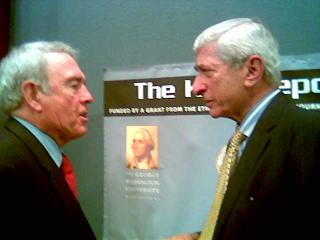
Kalb's warmup queries, before he got to the forged document scandal relating to the 60 Minutes II broadcast that didn't end up making any difference in the 2004 election because it was a hoax, were simply weird. Something about defining the difference between a journalist and a member of the media, and asking whether bloggers were members of the media or journalists. What Dan would know about this--or have credibility to discuss--was a mystery before, during, and after the questioning. Dan did say something about not all bloggers being bad, if they put their names and addresses on their blogs, but it was all very odd given that Dan had been caught pulling a fast one and still didn't admit it. If anyone isn't a journalist anymore, it is Dan--though he is obviously a member of the media. OK, maybe he's now a dishonest, unethical, and lousy journalist. Still...
Strangely, some people aren't fleeing from association with Dan Rather, unapologetic about forgeries or not. The event was sponsored by a who's who of establishment worthies in addition to the press club: The George Washington University, the Joan Shorenstein Barone Center for the Press, Politics, and Public Policy of Harvard University, XM Satellite Radio, AM 630 WMAL. It was taped for broadcast by WHUT, Howard University Television, as well as aired live by C-SPAN. The Kalb Report is funded by a grant from the "Ethics and Excellence in Journalism Foundation." I'm not even googling them, because I don't want to barf.
What can one say? Dan Rather obviously doesn't know much about ethics or excellence anymore--if he ever did. His answers to Kalb made clear that Dan believes the forged documents he peddled on 60 Minutes II in 2004 have not been discredited, despite the evidence that has been posted for the world to see on a number of websites--including this one (check our archives).

Dan loyally sticks by his story. He clearly sees himself as a victim of a powerful conspiracy of bloggers and political operatives. Marvin Kalb never pressed him, doing a Larry King type of show. When Dan wouldn't answer a question, he let it go. He praised Dan as a great reporter. He never said he was discredited. From time to time, when Dan gave some sort of Texas b.s. about integrity and speaking truth to power, Kalb would add something like: "I want to associate myself with that statement." So, in a way, Kalb is associating himself with forgery and stonewalling. It reminded me of the Nixon administration: "I am not a crook." Well, I'm sure Nixon believed it as much as Dan and Marvin Kalb. Dan talked a lot about loyalty to his team--four of whom at least lost their jobs because he didn't do his, by checking out his story before broadcast. Dan's still got a job. Producer Mary Mapes, however, doesn't.
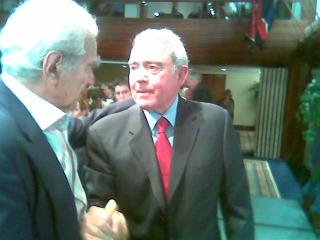
Curiously, there weren't too many actual working newsmen and women in the audience. And despite the students papering the room, there were still some empty seats. Perhaps a sign that they had better things to do, or that Dan's seemingly endless victory lap--after the Emmy awards--is wearing a bit thin. One who was there was Bernard Kalb, Marvin's brother. I talked with him afterwards, and asked him what his opinion was about the documents in question. He answered that he believed the Thornburgh report. I told him that I didn't, that anyone could see that the documents in question were obvious fakes by looking at them on the internet. I said I remembered what an IBM Selectric looked like, and asked him if he remembered. He admitted he remembered IBM Selectrics, but maintained that he still believed the Thornburgh report. When I questioned whether he could think for himself, if he had his own conscience, Bernard Kalb clung to his story. He and Dick Thornburgh were in perfect agreement. He would not question a former Republican Attorney General hired by Viacom. (So much for speaking truth to power...)
The audience was mostly George Washington University students, who seemed far too young to remember IBM Selectric typewriters. One of their professors, who apparently was a former CBS News employee from Marvin Kalb's introduction, clearly didn't teach them to ask hard questions of a CBS anchor or 60 Minutes host. To say it was a lovefeast would be an understatement.
The one hard question was seemingly unintentional. Marvin Kalb asked Dan something about his retirement, along with the death of Peter Jennings and retirement of Tom Browkaw, marking "the end of an era." Dan said it wasn't about anchors, it was about the news. He didn't seem to understand that while it is indeed a virtue to speak truth to power, it is not a virtue to speak lies to power.
Dan Rather has damaged his credibility to the point where his unravelling seams begin to show. Frankly, the evening was more than a little embarrassing to watch. It was very, very sad. It really is the end of an era.
UPDATE: More here from RadioBlogger. He calls Marvin Kalb and Dan Rather's conversation "elder abuse." (ht lgf) And even more from The New York Post. (ht Best of the Web)
 In fact, the close-up I took shows Dan looking like a character out of Dostoevsky.
The evening was strangely painful for me, because I grew up in a CBS household, believing in Edward R. Murrow, Walter Cronkite and the rest of them. When I made my film, I had help from CBS Reports producer Arthur Morse's widow, who arranged for me to view never-broadcast footage in an editing room in the CBS News building on West 57th Street. When I wrote my book about PBS, Morley Safer granted me a telephone interview. I had met 60 Minutes creator Don Hewitt's daughter socially in Washington and thought she was really very nice. Don Hewitt himself once gave me a phone interview. And a cousin of my father's had a CBS station in the Pacific Northwest. Even after Walter Cronkite attacked me in the Wall Street Journal, I still believed that CBS News had some higher standard than other networks. Call it early childhood imprinting.
In any case, the evening reminded me that my childhood beliefs were as unfounded as faith in the Easter Bunny or Tooth Fairy. Marvin Kalb began the whole thing by bringing up Spiro Agnew, a discredited former Nixon administration official, who like Rather, pleaded no lo contendere. I don't think he knew he was being ironic.

Kalb's warmup queries, before he got to the forged document scandal relating to the 60 Minutes II broadcast that didn't end up making any difference in the 2004 election because it was a hoax, were simply weird. Something about defining the difference between a journalist and a member of the media, and asking whether bloggers were members of the media or journalists. What Dan would know about this--or have credibility to discuss--was a mystery before, during, and after the questioning. Dan did say something about not all bloggers being bad, if they put their names and addresses on their blogs, but it was all very odd given that Dan had been caught pulling a fast one and still didn't admit it. If anyone isn't a journalist anymore, it is Dan--though he is obviously a member of the media. OK, maybe he's now a dishonest, unethical, and lousy journalist. Still...
Strangely, some people aren't fleeing from association with Dan Rather, unapologetic about forgeries or not. The event was sponsored by a who's who of establishment worthies in addition to the press club: The George Washington University, the Joan Shorenstein Barone Center for the Press, Politics, and Public Policy of Harvard University, XM Satellite Radio, AM 630 WMAL. It was taped for broadcast by WHUT, Howard University Television, as well as aired live by C-SPAN. The Kalb Report is funded by a grant from the "Ethics and Excellence in Journalism Foundation." I'm not even googling them, because I don't want to barf.
What can one say? Dan Rather obviously doesn't know much about ethics or excellence anymore--if he ever did. His answers to Kalb made clear that Dan believes the forged documents he peddled on 60 Minutes II in 2004 have not been discredited, despite the evidence that has been posted for the world to see on a number of websites--including this one (check our archives).

Dan loyally sticks by his story. He clearly sees himself as a victim of a powerful conspiracy of bloggers and political operatives. Marvin Kalb never pressed him, doing a Larry King type of show. When Dan wouldn't answer a question, he let it go. He praised Dan as a great reporter. He never said he was discredited. From time to time, when Dan gave some sort of Texas b.s. about integrity and speaking truth to power, Kalb would add something like: "I want to associate myself with that statement." So, in a way, Kalb is associating himself with forgery and stonewalling. It reminded me of the Nixon administration: "I am not a crook." Well, I'm sure Nixon believed it as much as Dan and Marvin Kalb. Dan talked a lot about loyalty to his team--four of whom at least lost their jobs because he didn't do his, by checking out his story before broadcast. Dan's still got a job. Producer Mary Mapes, however, doesn't.

Curiously, there weren't too many actual working newsmen and women in the audience. And despite the students papering the room, there were still some empty seats. Perhaps a sign that they had better things to do, or that Dan's seemingly endless victory lap--after the Emmy awards--is wearing a bit thin. One who was there was Bernard Kalb, Marvin's brother. I talked with him afterwards, and asked him what his opinion was about the documents in question. He answered that he believed the Thornburgh report. I told him that I didn't, that anyone could see that the documents in question were obvious fakes by looking at them on the internet. I said I remembered what an IBM Selectric looked like, and asked him if he remembered. He admitted he remembered IBM Selectrics, but maintained that he still believed the Thornburgh report. When I questioned whether he could think for himself, if he had his own conscience, Bernard Kalb clung to his story. He and Dick Thornburgh were in perfect agreement. He would not question a former Republican Attorney General hired by Viacom. (So much for speaking truth to power...)
The audience was mostly George Washington University students, who seemed far too young to remember IBM Selectric typewriters. One of their professors, who apparently was a former CBS News employee from Marvin Kalb's introduction, clearly didn't teach them to ask hard questions of a CBS anchor or 60 Minutes host. To say it was a lovefeast would be an understatement.
The one hard question was seemingly unintentional. Marvin Kalb asked Dan something about his retirement, along with the death of Peter Jennings and retirement of Tom Browkaw, marking "the end of an era." Dan said it wasn't about anchors, it was about the news. He didn't seem to understand that while it is indeed a virtue to speak truth to power, it is not a virtue to speak lies to power.
Dan Rather has damaged his credibility to the point where his unravelling seams begin to show. Frankly, the evening was more than a little embarrassing to watch. It was very, very sad. It really is the end of an era.
UPDATE: More here from RadioBlogger. He calls Marvin Kalb and Dan Rather's conversation "elder abuse." (ht lgf) And even more from The New York Post. (ht Best of the Web)
Nazim Tulyahodjaev Returns to Uzbekistan
 (Ferghana.ru photo) We called him "Uncle Nazim" (he was our translator's uncle) when we lived in Tashkent. He struck us as one of the most multi-talented people we had ever met: actor, painter, director, animator, you name it. He produced and directed a 1984 adaptation of Ray Bradbury's Farenheit 451 called There Will Come Soft Rains. A genuine "Renaissance Man." He gave us a tour of UzbekFilm studios, before leaving the country. Now, Nazim Tulyahodjaev has returned to Uzbekistan to make another film. We look forward to seeing it--and hope Hollywood discovers him.
Don't Turn Over Emergency Response to the Military
 (White House photo by Eric Draper)
According to news reports, President Bush is considering turning over emergency response to the Pentagon.
It's a bad idea, and it will just make matters worse.
Leave aside the constitutional problems. The major flaw is that such a responsibility overburdens a military already stretched to the limit in Iraq and Afghanistan. Simply put, there aren't enough troops to do the job--and if there were, it would hurt America's ability to respond to terrorist or other military attacks.
So, even if passed, it would not work.
But more than that, it shows that Bush is in desperation mode--unable to govern democratically, he seeks to resort to military solutions to domestic problems. That he's even thinking this way, it seems to me, is evidence that he has "lost it."
The US had dealt with flood, fire, hurricane, earthquake, and myriad natural calamities for hundreds of years without turning into a military dictatorship. If Bush can't find civilian solutions to civil problems--he ought to resign.
The Opening of the American Mind
I had seen the ads for taped lectures from The Teaching Company, and a few years before had met Alan Kors, who recorded a series of lectures on Voltaire, but until dinner last Friday with a professor who had come to tape a series of talks on Russian Literature, I didn't know much about the operation. Turns out they have their own recording studio, and the people involved appear to be knowledgeable and dedicated. My dinner companion said he had enjoyed the experience.
Suddenly, it seemed less like a kitschy mail-order self-improvement great books thing, and more like a serious effort to spread learning, while making some money at the same time. The company was founded by Thomas Rollins, former chief counsel for the Senate Labor and Human Resources committee. He felt teaching was undervalued, and wanted to do something to promote great university teaching. Well, as a teacher, I certainly agree with that mission.
To judge from the website, he's done what he set out to do. Here's an excerpt from Philip Daileader's lecture on the state of universities in the High Middle Ages, relevant to a lot of us adjuncts and part-timers today:
Perhaps when the history of teaching is taught a few centuries from now, a professor will cite the Teaching Company as an alternative to Allan Bloom's Closing of the American Mind...
UPDATE: Here's an article on the subject from The Chronicle of Higher Education
Suddenly, it seemed less like a kitschy mail-order self-improvement great books thing, and more like a serious effort to spread learning, while making some money at the same time. The company was founded by Thomas Rollins, former chief counsel for the Senate Labor and Human Resources committee. He felt teaching was undervalued, and wanted to do something to promote great university teaching. Well, as a teacher, I certainly agree with that mission.
To judge from the website, he's done what he set out to do. Here's an excerpt from Philip Daileader's lecture on the state of universities in the High Middle Ages, relevant to a lot of us adjuncts and part-timers today:
Although all universities were founded for more or less the same reasons, nonetheless, two different types of universities emerged in the High Middle Ages. Paris and Bologna were rather different institutions, in many respects. They were different in terms of their academic specialties, and they were different in terms of their structures.
Paris was best known for theology. Bologna was best known for its law faculty, especially its civil law and secular law courses. The differences in structure often reflected these differences in academic specialization. The University of Paris was run by the teachers, magister, or "master," in the singular, magistri in the plural, whereas the University of Bologna was run by the students, not by the faculty. All medieval universities followed one of these two models, either the master-dominated University of Paris, or the student-dominated University of Bologna.
The reason for these different structures was the manner in which teachers were paid. Theoretically, no teacher was ever supposed to charge money, or demand money for teaching. All teaching should have been done for free, because knowledge was God's gift to humanity, and for a human being to charge money for that which was actually God's, was presumptuous. The teacher was to rely solely on gifts, freely given by students out of gratitude for the fact that teachers had shared God's knowledge with them. In practice, this was a highly unsatisfactory system of remunerating teachers; one who had to show up in class, and pray that someone gave him an apple, so that he could eat that day, and different sorts of arrangements had to be reached, whereby teachers could feed themselves.
In Paris, because it was so strong in theology, and the theology faculty really dominated the university, most teachers were supported by the Church. They were given salaries, called benefices, that they were able to live off of. Because the teachers in Paris, for the most part, did not have to rely on student gifts, but rather, were paid by the Church, they were free of student control, and were able to run the university as they saw fit.
At Bologna, with its strength in the law faculty, especially in secular law and in civil law, teachers had to rely on student fees directly for their livelihood, and since students were paying their salaries, students got to run the university. Indeed, modern teachers can only shudder with horror when they see the consequences for the poor faculty members at the University of Bologna. If you had been a master teaching at the University of Bologna, and you wanted to leave town for any reason, a getaway weekend, etc., you had to post bond with the students, guaranteeing that you were going to return to the University of Bologna, and actually teach your classes.
Teachers were fined for all sorts of infractions by the student body; I hope they don't see this tape. If you failed to attract five students to your class on any given day, you, the teacher, were marked as absent, because you had failed to gather a quorum, and you were fined for having been absent, even though you had been physically present. If you failed to keep pace with the syllabus, and you fell behind on your lecturing schedule, that, too, was a fine that you had to pay. If you were late for class, well, that was also a fine. It could be rather lucrative to be a student at the University of Bologna.
The manner in which the master's salary was negotiated at Bologna also seems rather odd today. At the beginning of an academic semester, during the first meeting of class, you as the master would choose one student from the class, a student whom you trusted. That student was given the responsibility of negotiating your fee for that semester with the student body. You, then, had to exit the room and sit outside anxiously, while the student, on your behalf, talked with the other students about how much you were actually worth. Given the fact that the student negotiating your fee had to pay whatever fee was negotiated, the results were not always that lucrative from the master's point of view. If you as a master had a choice between an appointment at the University of Paris, or the University of Bologna, well, that was a no-brainer. You wanted to go teach at Paris.
Perhaps when the history of teaching is taught a few centuries from now, a professor will cite the Teaching Company as an alternative to Allan Bloom's Closing of the American Mind...
UPDATE: Here's an article on the subject from The Chronicle of Higher Education
Sunday, September 25, 2005
A Russian Blog From New Orleans
It's called SpeakRussian, hosted by Natalia Worthington, whom I discovered by looking for Russian podcasts. On her site, or via podcast, you can hear her impressions of Hurricane Katrina and the flood, as well as pick up a few Russian words...
Human Rights Watch Report: 82nd Airborne Tortured Prisoners
After looking at this report, I thought, the US has no right whatsoever to complain about any other country's treatment of prisoners--until we have cleaned up our own act...
Subscribe to:
Posts (Atom)